MR. KOJO NNAMDI
12:06:45
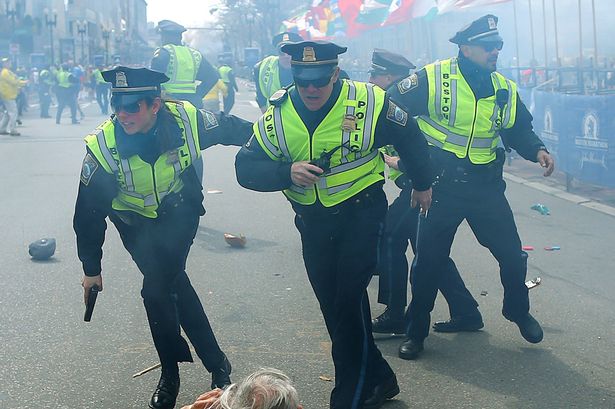
From WAMU 88.5 at American University in Washington, welcome to “The Kojo Nnamdi Show,” connecting your neighborhood with the world. Later in the broadcast, unearthing the stories and the recipes behind black bartenders who lived through prohibition and racial discrimination in Washington, D.C., but first, the modern nature of Monday’s bombings at the Boston Marathon and the scramble to get to the bottom of it all.
MR. KOJO NNAMDI
12:07:22
Investigators are still digging into who was responsible for those explosions, which killed at least three people and injured more than 170. They’re calling on those who were near the finish line to handle their video and photos they may have taken around the time of the blast, a task that could involve sifting through thousands of hours of tape and an ocean of data. Meanwhile, the immediate emergency response to the bombings also reflected the times we now live in and events unfold in front of thousands of cameras and spill over immediately into the sprawl of social media.
MR. KOJO NNAMDI
12:08:00
Joining us in studio to discuss this is Todd Jasper. He is associate director of the Homeland Security and Emergency Management Vision at MSA, consulting firm here in Washington. He’s also vice chair of the Emerging Technology Caucus for the International Association of Emergency Managers and the education director for the Metropolitan Washington Association of Contingency Planners. Todd Jasper, thank you for joining us.
MR. TODD JASPER
12:08:28
A pleasure.
NNAMDI
12:08:29
Joining us by phone is Alexis Madrigal, senior editor at The Atlantic where he writes about technology. Alexis, thank you for joining us.
MR. ALEXIS MADRIGAL
12:08:37
Thanks for having me.
NNAMDI
12:08:38
Todd, I’ll start with you. It’s being reported now that there was a letter or a package sent to the White House containing an undisclosed substance that is apparently dangerous, and that comes on the heels of reports that a package sent to Mississippi Republican Roger Wicker contained rice and looks as if we’re dealing with a lot of emergencies at the same time. Any thoughts about this at all?
JASPER
12:09:05
When it rains, it pours, it seems like. It makes us think back to late 2001, early 2002 where we had the obviously 9/11, followed by anthrax attacks. So it seems like we’re getting terrorism in all sorts of forms simultaneously. Luckily, it seems like everyone is pretty well-prepared. It was sent to the White House that we know about. It didn’t actually reach there. It was screened and interrupted before it got to reach its destination.
NNAMDI
12:09:34
But in the other case of the rice and, again, it didn’t reach the member himself, but it is obviously when you point out that what happened the last time after 9/11, one has to try to figure out what the heck is going on. But we won’t speculate too much about that. Turning to Boston, all you have to do is listen to the radio traffic from the Boston Police Department on Monday to begin understanding the thoroughly modern nature of that moment.
NNAMDI
12:10:02
Within a matter of minutes, you hear a commander to be giving orders to begin using social media to let people sheltering in restaurants and hotels around the site know that explosive ordinance disposal teams were passing through. Here’s some of that sound.
UNIDENTIFIED MAN
12:10:20
We’re going to get the victims out. We’re going to conduct a sweep with DOD assets to make sure there are no other devices on the streets. We will then get people out of the restaurants and bars. I need somebody up there to get on social media and let people know what we’re doing here that we’re sweeping the streets to make sure it’s safe first, and then we’ll get them out of the bars and stuff once we get it swept.
NNAMDI
12:10:41
Todd, to what degree do you think what happened on Monday is indicative of how we’re living in a new era both of emergencies and of emergency response.
JASPER
12:10:49
It’s extraordinary. We are seeing more involvement from not just first responders but from everyday citizens in emergency situations and creating what we call emergency management, the common operating picture and using new technology, nontraditional methods for it. Although, you know, every middle school or high school would say that social media is pretty traditionally common to them.
JASPER
12:11:12
It wasn’t too long ago that the D.C. Fire public information officer was relieved of his position because he tweeted too much, and the reasoning was social media is for parties. We’re not having any parties here. And it’s changed a lot. Being very progressive recognizing that the citizens are part of the response, understanding that — honestly, if you look at pictures and videos of 9/11, of, obviously, the Boston Marathon bombings, what you see is who are the first people around.
JASPER
12:11:40
I mean the police and fire there, sure. But the very crucial, as crucial as the folks that are first responders in their own right and are carrying people to safety, their fellow citizen. And so being able to engage with everyone is so important. And this commander was extraordinarily progressive in that mindset.
JASPER
12:11:56
And no sooner that he ordered the EOD, which is the explosive ordinance disposal teams, into the area but he also ordered headquarters to start using social media, start engaging with the public. I think that’s an extraordinary statement as to his forward thinking about being able to involve the public and also try to reassure people.
NNAMDI
12:12:13
Alexis Madrigal, investigators are now calling witnesses near the finish line to hand over any videos or photos they may have. You wrote that this is also a sign of the times that major events are unfolding in front of human eyes and in front of thousands of potential photographers and videographers at any given moment.
MADRIGAL
12:12:33
It’s true. I mean I think one thing we’ve seen particularly in large events, like the Vancouver riots, the riots in London, is that there’s just truly thousands of hours of video now that investigators have to deal with and all kinds of different formats. I mean, there’s not just a video that citizens are producing with their smartphones. There’s also the CCTVs that are likely along Boston where the bombings happened and a lot — I’ve been talking with video forensic experts. A lot of the hard part is actually just the practical stuff. How do you get a hold of the evidence itself?
MADRIGAL
12:13:07
They want it in the uncompressed format, so they want to get a hold of the actual phones themselves, the actual CCTV recorders. And then they’ve got to get all that stuff into a system that they can then work and tag and look for events and people of interest. And so there are, in fact, established methodologies for dealing with all those things, and they’ve only emerged in the last couple of years.
NNAMDI
12:13:34
800-433-8850 is the number to call if you have questions or comments about Boston, technology, emergency response. 800-433-8850. You can send email with your question or comment to kojo@wamu.org, or you can send us a tweet, @kojoshow. You can also go to our website, kojoshow.org, and join the conversation there.
NNAMDI
12:13:55
Do either of you expect this is likely to change the conversation about security cameras and law enforcement in the United States? There’s a marathon that’s about to take place in London. It’s a public event that will go down in front of the full view of the entire CCTV system there. First, you, Alexis.
MADRIGAL
12:14:16
It’s interesting. I mean I wish we could have more of a public debate about the present of this kind of surveillance. I think, you know, in certain circumstances, it does seem to be they’re useful. I think in other circumstances, there’s been a lot of questions about it, its efficacy just kind of for day-to-day crime prevention in London and in England more generally where they have way more CCTVs than we do.
MADRIGAL
12:14:44
I think, you know, for me, sort of the big questions are, are the kinds of systems that the government puts in place for surveillance are they the kind of systems that we would want generally speaking to have in place. If we kind of can’t get blinded by the technological aspects of these things, I think we have to examine them within the general values that society has.
NNAMDI
12:15:06
Your turn, Todd.
JASPER
12:15:08
Absolutely. You know, we have to look at the reasons why London has so many CCTV cameras, due to the IRA bombings. We are a culture that likes freedom, privacy.
NNAMDI
12:15:21
Especially in Boston.
JASPER
12:15:23
Of course. And I think that it’s fine balancing act, try and determine transparency and security versus privacy and some — anonymity in the public sphere.
NNAMDI
12:15:36
I was reading, well, one of my favorite crime novelists, Dennis Lehane, had an op-ed in The New York Times today. Of course, he’s a Bostonian, and he said: Look, we are going to find these people, and we are going to move on with our lives. We’re not going to panic and introduce all kinds of security measures that invade people’s privacy. But I guess I suspect that debate is probably likely to take place in Boston also, isn’t it, Todd?
JASPER
12:16:00
Well, yeah. There’s been a long tradition that you don’t have privacy necessarily in open places. There’s no reason for privacy when you’re walking down the street. People can see you. You’re not invisible. So it’s — a lot of folks would say having security cameras in public places is probably not much an invasion, but a lot of folks will also have the other opinion that that’s not something they want to sign up for.
JASPER
12:16:22
But we — again, we do have to balance security with it. He says we’ll find these people, but how will we find them. We might have video of them. It might be because of some really forward thinking security systems or processes or programs that established certain zones where we can surveil the public to make sure that something is spotted that’s an unattended package.
JASPER
12:16:45
For instance, New York City Police Department has one of the most technologically advanced systems out there. They have programs. They don’t actually necessarily have a person watching every single second of video coverage, but what they do have is software that can monitor and see if someone leaves a package unattended. And they can have a bomb squad respond to that or a police officer.
JASPER
12:17:09
In fact, they can even search based on — if someone said there was a person wearing a red shirt that robbed a bank, they can query the system to identify if a person wearing a red shirt ran down that street. So there are some very technologically advanced methodologies that we can be using that are starting to become more popular, but it’s always obviously a debate between privacy and security.
NNAMDI
12:17:31
Well, Alexis Madrigal, in the wake of Newtown, Conn., the debate about gun control and gun regulations certainly was ramped up. You think this incident can lead to a ramping up in the debate over CCTVs?
MADRIGAL
12:17:45
Yes. I think it might. I mean, I think when one of the big problems in a lot of these systems that we don’t really have a lot of ways to evaluate the efficacy, right? I mean, the New York system or the London system, that we kind of have to just take law enforcement’s word for it that these things are working, or they’re making us safer. And I think that’s one of the big problems is once we get into these kinds of technical realms, you know, we can’t just say, is this actually making us safer or not.
MADRIGAL
12:18:10
We have to know about some of the technical innards, and we have to figure out ways of having some communal decision-making around those kinds of technologies. I think right now at least, you know, and talking to video forensics people, specific to Boston, it doesn’t seem like a lot of automated tools can be brought to bear. It’s going to be human beings doing the tapes. And I think one of the big differences between, you know, a single event where a lot of media is collected, is that there are going to be a lot more investigators available.
MADRIGAL
12:18:44
And so you sort of — there’s going to — the human side of the investigation will remain where these systems are deployed over an entire city all the time, the scale of it sort of requires automation in some ways. And I think that is where it gets into some more difficult privacy issues because, once you start deploying more and more automated systems, you know, is it a different — is it a difference in scale or type of surveillance?
MADRIGAL
12:19:13
And I think once you start deploying software that can identify someone, say, walking through a city anywhere, is that actually different in the eyes of the law or in the eyes of citizens than just a police officer being able to watch when there’s some sort of Supreme Court cases that are finding that while a police officer could follow you in a car anywhere they wanted to, if they attach a GPS to your car, that’s actually different.
MADRIGAL
12:19:36
And I think there’s some sort of key issues around some of these things when the technology actually changes the type of surveillance in the eyes of the law or the people.
NNAMDI
12:19:49
Todd, authorities put out a call pretty quickly for people to limit cellphone use after the explosions to avoid detonations of other devices that may have been in the area. There were mixed stories about whether or not law enforcement actively ordered cellphone networks to be shut down. What’s the process that people typically follow in these types of situations? I noticed that you tweeted on Monday, encouraging people to avoid using cellphones and radios.
JASPER
12:20:13
Right. The standard operating procedure after what we call an IED or an improvised explosive device, which could be triggered remotely using wireless devices, is to limit the use. We don’t want to absentmindedly or accidentally set off additional or secondary devices based on using our cellphones. In fact, the standard procedure for law enforcement and fire, too, is to try to really limit the use of radio and cellphone communications at time.
NNAMDI
12:20:43
Are there methods of communication that are typically the best bet for both the responders and for the public in situations like this, text? I’ve heard from people with BlackBerries that PIN networks tend to be pretty reliable also.
JASPER
12:20:55
Well, the concept’s the same. If you’re sending or receiving a message of any type, it’s using wireless frequency to do that. You know, besides just having two cans and a string, you know, really, landline was the only — any kind of process where you’re not using wireless frequency to transmit a message if you’re in the area where there might be explosives. It sounds like we find ourselves in a whole lot. But when we do, it’s best to be cautious about that kind of thing.
NNAMDI
12:21:21
You wrote on your blog about whether technologies are emerging that can better so-called soft targets — better protect so-called soft targets from attacks. These bombings took place smack dab in the middle of one of the biggest public gatherings that Boston stages every year. What, in your view, can be done from a technological standpoint to make events like this safer? Or is this simply the reality of the world we live in, that if someone wants to attack a shopping mall or an open public place that there’s only so much you can do to stop it?
JASPER
12:21:52
It’s about — really, the conversation is about how we can we empower citizens to be alert and aware to their surroundings if there is an unattended package. And then second is to make the means of communicating, the perceived threat or an unattended package or suspicious circumstances or persons, any way it would — any one of those, so easy that they can do it effortlessly. Frederick County in Maryland just released — part of their new 911 system is you can text 911. You could send them a picture.
JASPER
12:22:24
You could send them a request for service or something like that. So being able to contact emergency services discreetly might be something that’s easily done and could prevent future attacks. If someone — put yourself in someone’s shoes. If you’re at the Boston Marathon and you saw someone who looks suspicious, might have heavy nylon bags that seem to be clunking around, are you going to feel comfortable picking up your phone and calling 911 at that point trying to report that?
JASPER
12:22:51
That might be easier said than done. So being able to enable people to report things using their cellphone, but not necessarily using voice communications might be helpful. And also, many different cities have some apps to report or to at least provide guidance on what things might be suspicious and how to report them.
NNAMDI
12:23:10
And finally, are there best methods of communications for both the responders and for the public in situations like this? The inter-operability issue where there are responders coming from different jurisdictions, there needs to be a reliable way for them all to communicate with each other and, I guess, with the public. What’s your sense for the progress we’ve made on issues like that here in the Washington region?
JASPER
12:23:34
Especially in the Washington region, we’ve been — we’re head and shoulders about where we were in 9/11. In the Metropolitan Washington region, the national capital region, almost every department and not even just the counties, but individual cities that have their own police departments are all on the shared radio system.
JASPER
12:23:52
So they can talk to each other very easily. In fact, Montgomery County, if there’s large fire in Montgomery County, sometimes they’ll call on Fairfax County to send over fire engines to sit in their stations to backfill their stations. And it happens all the time, and it’s effortless. And that kind of mutual aid goes around the — around the whole region.
NNAMDI
12:24:13
And reduces the likelihood that we in public will be getting different messages from different agencies?
JASPER
12:24:18
Well, that’s the next thing is once you have inter-operable communications, you’re going to have information that’s shared through a lot of different agencies. How do you filter that so the public gets what they need in a timely manner? And, you know, for this Boston example, we see the commander immediately turning to social media, and they have a great PIO or public information officer who gave out a lot of information via Twitter very quickly so that there was rapid, real facts being distributed not just speculation.
JASPER
12:24:46
So it’s a fine art making — when you have multiple jurisdictions responding to an incident, especially a notorious incident like a bombing or something that might tied to terrorism is making sure that the message is consistent so that all these — all these agencies exercise and communicate on a routine basis so that that is a very fluid process and makes it the best service.
NNAMDI
12:25:06
Todd Jasper is associate director of the Homeland Security and Emergency Management Vision at MSA, a consulting firm in Washington, D.C. Todd Jasper, thank you for joining us.
JASPER
12:25:15
My pleasure.
NNAMDI
12:25:16
Alexis Madrigal is a senior editor at The Atlantic where he writes about technology. Alexis, thank you for joining us.
MADRIGAL
12:25:21
Thank you very much.
NNAMDI
12:25:23
We’re going to take a short break. When we come back, we’ll be unearthing the stories and the recipes behind black bartenders who live through prohibition and racial discrimination here in Washington. I’m Kojo Nnamdi.








 toddjasper