• About Todd
  • Best of the Blog
  • Memes
  • Reading List
  • Todd’s Publications

toddjasper

~ Amat victoria curam

toddjasper

Monthly Archives: May 2012

Chevy Chase Patch: “Click It or Ticket” Comes to Chevy Chase

29 Tuesday May 2012

Posted by toddjasper in EMERGENCY MANAGEMENT

≈ Leave a comment

Every month I have an emergency preparedness article in the local newspaper (ChevyChase.Patch.com). Here’s the link to my May article. I’ve also copied it below:

Since Maryland passed its mandatory seat belt law in 1997, the annual number of traffic-related injuries in Maryland has decreased by more than 26 percent (MD State Highway Administration).

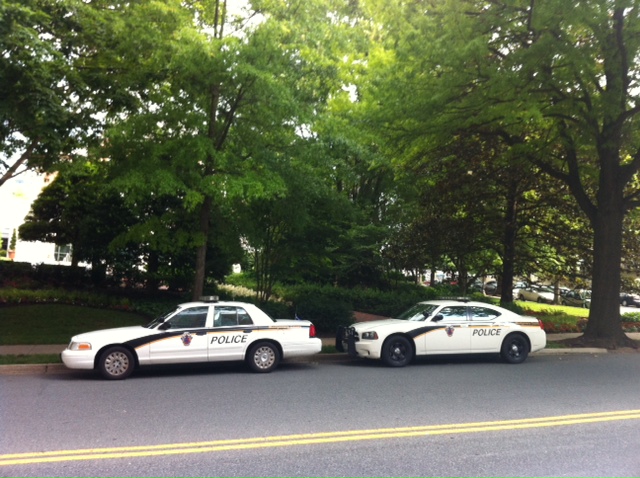
The famous security guard statue at the intersection of South Park Avenue and The Hills Plaza is getting some company this summer—in the form of uniformed police officers from the Montgomery County Police Department.

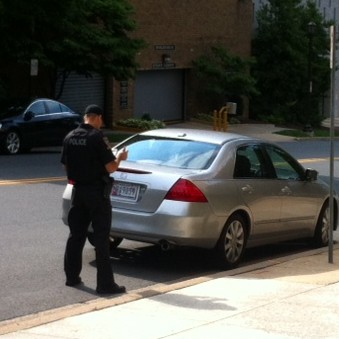
As part of the Maryland “Click It or Ticket” campaign, residents may notice police officers standing outside their parked patrol vehicles—especially at the intersection of South Park Avenue and The Hills Plaza in Chevy Chase, where officers have established a checkpoint several weeks in a row. Police officers are monitoring passing vehicles for seat belt use and are conducting traffic stops when they spot violations.

Montgomery County police officers are targeting certain intersections for approximately two hours at a time. In Chevy Chase, officers say they prefer the intersection near the the security guard statue because it offers clear lines of sight for seeing if drivers are
wearing their seat belts, and vehicles are traveling at slower speeds than on larger roads, such as Wisconsin Avenue.

According to Charles County, MD’s traffic website, seat belt fines are $25 but can be more if minors in the vehicle are not buckled in. Throughout May and June, Maryland law enforcement officers will be aggressively enforcing Maryland’s seat belt laws.

Todd Jasper is a federal emergency manager and has been happy to call Chevy Chase home since 2008. His emergency management blog is www.toddjasper.com.

Share this:

  • Email a link to a friend (Opens in new window) Email
  • Share on X (Opens in new window) X
  • Share on Facebook (Opens in new window) Facebook
  • Share on Pinterest (Opens in new window) Pinterest
  • Share on Reddit (Opens in new window) Reddit
Like Loading...

Office Floor Wardens: Defying Safety & Logic

20 Sunday May 2012

Posted by toddjasper in EMERGENCY MANAGEMENT

≈ 6 Comments

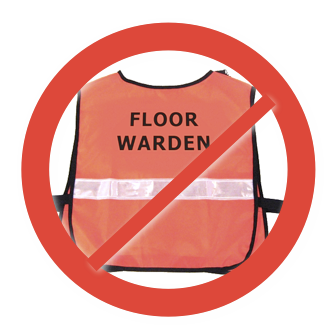
Many companies and even Federal agencies have identified volunteers on every floor of their buildings to act as “floor wardens” during a fire alarm. One agency has  instructions on their website to their floor wardens about their duties during a fire alarm:

The floor warden team is responsible for checking where the fire activation is, checking with other floor wardens that the building is empty, and liaising with the Fire Department. A member of the team will also record the event and investigate if  necessary.

This conduct is common for floor wardens. They are expected to perform a search for people, investigate the source of fire, urge people to evacuate that haven’t left their desks, and rescue those that are trapped.

What equipment do they have? A reflective vest, flashlight, and perhaps a whistle!

What training do they have? They are shown the location of the stairwells, told where outside they should send people, and are instructed to write down the names of people that refuse to evacuate.

In my opinion, the floor warden system is seriously flawed and extremely dangerous. There are so many issues with the system, it’s hard to know where to start.

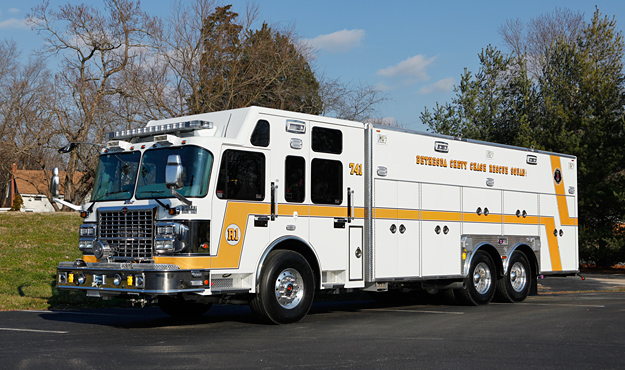
First, it’s hard enough for the professional rescue squad that the fire department sends to perform search and rescue–and rescue squads have extensive training and equipment (such as air supply, tools, radios, helmets, fire resistent person protective equipment, and other specialized equipment). Floor wardens have none of this equipment or training.

Additionally, rescue squads function as a team of professionals and have an ability to relay information up the chain of command. A rescue squad can receive an order from the chief to abort a rescue and regroup in safety. The floor wardens usually operate alone (rarely in pairs) and are lucky to even have a radio.

The idea that floor wardens are supposed to investigate a fire is absolutely ludicrous. If a fire department announced that, in order to save money, when it receives a call for fire, the fire department would first dispatch a civilian with no fire training and no personal protective equipment to enter the burning building and investigate, the community would be rightfully outraged. Yet that same mission is given to floor wardens when the fire alarm sounds.

In addition to a lack of equipment and woefully inadequate training, the liability of the floor warden system is absolutely extraordinary. Let’s take a step back and analyze their roles: when the fire alarm sounds, the floor wardens are instructed by their bosses NOT TO EVACUATE. OSHA requires that employees operating in an environment with smoke and/or fire have proper personal protective equipment (PPE) such as respiratory protection, eye protection, helmets, and fire retardent clothing. Fire doubles in size about every 30 seconds–and unequipped floor wardens are sitting ducks. Operating on the fireground without proper PPE is not just dangerous, but really foolish and comes with incredible liability for a company that orders some employees to stay put during a fire.

Additionally, the International Fire Code is very clear:

23.11.401.9 International Fire Code Section – Evacuation required. In the event of activation of a fire, emergency alarm, or at the direction of the fire code official, occupants of the building or portion of the building in which the alarm is activated shall make a safe and orderly evacuation out of the building

Notice that the IFC doesn’t say “let your volunteers wander around the fire without protective equipment or extensive fire training on the lookout for folks who refuse to evacuate.”

It shouldn’t require that a floor warden perish in a fire before the emergency management field examines this practice and then prohibits it.

Unfortunately, it seems like floor wardens are supposed to be a stop-gap measure for poor emergency training among office workers. Why force everyone to undergo annual evacuation and emergency procedures training when the floor warden will just tell me what to do during an emergency? This is not the right perspective. Everyone ought to go through annual and refresher emergency training under the expectation that NO ONE will be available to remind them what to do during the emergency.

In many ways, the floor warden system establishes unreasonable expectations. For the sake of argument, let’s say that floor wardens were properly equipped and trained and worked in teams–what happens when they call in sick or go on vacation or go to lunch? Floor wardens themselves may have unrealistic–and dangerous–expectations of performing lifesaving rescues and braving the flames to help others. We ought to squash fantasies of tombstone heroism (heroic acts that end in a tombstone epitaph) and instead provide realistic and pragmatic duties (such as accountability at the evacuation rendezvous/rally point or triage outside the building). None of the pragmatic duties I mention entail people staying inside a building after the fire alarm sounds.

Some folks point out that floor wardens are useful for holding the door open to the stairwell during evacuations. The problem here is that in most buildings, during a fire alarm, the stairwells are positively pressurized to keep smoke from filling the stairwell like a chimney. If each floor warden were to hold open the doors on each floor throughout an evacuation, the positive pressurization would fail to be effective. Thus, it’s actually best if the wardens do not hold the doors open!

Others say that studies have shown that people respond better to people in authority during an evacuation–thus the need for floor wardens with vests.  That’s true, but studies have also shown that “evacuees are more likely to follow the instructions of uniformed officials (e.g., police and firefighters) than subway workers [or other non-public safety personnel], due to their perceptions of the authority and confidence of the firefighters and police officers.” If firefighters are proven to be even more successful at getting folks to evacuate, then why waste the effort with ineffective floor wardens?

The Community Emergency Response Team (CERT) training program does a good job of explaining two key principles of emergency response: “Do the greatest good for the greatest number” and “Don’t bring another victim to the scene” (meaning yourself). Floor wardens should be repurposed to do the greatest good for the greatest number that evacuate outside. Too, floor wardens can avoid bringing another victim to the scene by evacuating with everyone else when the fire alarm sounds.

In the end, I hope that building management companies, businesses, and agencies and organizations of all types abandon the floor warden system before someone gets seriously injured or killed. The myths that serve as justification to maintain the program are easily disproven and there’s no use keeping the program as a tradition when it has the potential of terrible legal liability and the potential for injury/death.

Share this:

  • Email a link to a friend (Opens in new window) Email
  • Share on X (Opens in new window) X
  • Share on Facebook (Opens in new window) Facebook
  • Share on Pinterest (Opens in new window) Pinterest
  • Share on Reddit (Opens in new window) Reddit
Like Loading...

Identifying Technological Gaps in Your Digital Toolbox

07 Monday May 2012

Posted by toddjasper in EMERGENCY MANAGEMENT

≈ Leave a comment

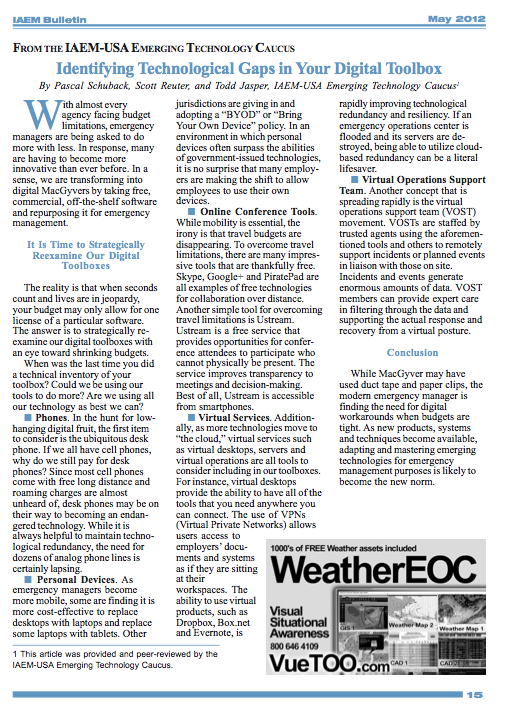
An Excerpt from the May 2012 Bulletin of the
International Association of Emergency Managers (IAEM)

Here’s a plain text version as well:

Identifying Technological Gaps in Your Digital Toolbox
By Pascal Schuback, Scott Reuter, and Todd Jasper, IAEM-USA Emerging Technology Caucus

With almost every agency facing budget limitations, emergency managers being asked to do more with less. In response, many are having to become more innovative than ever before. In a sense, we are transforming into digital MacGuyvers by taking free, commercial-off-the-shelf software and repurposing it for emergency management.

The reality is that when seconds count and lives are in jeopardy, your budget may only allow for one license of a particular software. The answer is to strategically re-examine our digital toolboxes with an eye towards shrinking budgets. When was the last time you did a technical inventory of your toolbox? Could we be using our tools to do more? Are we using all our technology the best we can?

  • PHONES In the hunt for low-hanging digital fruit, the first item to consider is the ubiquitous desk phone. If we all have cell phones, why do we still pay for desk phones? Since most cell phones come with free long distance and roaming charges are almost unheard of, desk phones may be on their way to becoming an endangered technology. While it is always helpful to maintain technological redundancy, the need for dozens of analog phone lines is certainly lapsing.
  • PERSONAL DEVICES As emergency managers become more mobile, some are finding it is more cost-effective to replace desktops with laptops and replace some laptops with tablets. Other jurisdictions are giving in and adopting a “BYOD”, or “Bring Your Own Device” policy. In an environment in which personal devices often surpass the abilities of government-issued technologies, it is no surprise that many employers are making the shift to allow employees to use their own devices.
  • ONLINE CONFERENCE TOOLS While mobility is essential, the irony is that travel budgets are disappearing. To overcome travel limitations, there are many impressive tools that are thankfully free. Skype, Google+, and PiratePad are all examples of free technologies for collaboration over distance. Another simple tool for overcoming travel limitations is Ustream. Ustream is a free service that provides opportunities for conference attendees to participate who cannot physically be present. The service improves transparency to meetings and decision-making. Best of all, Ustream is accessible from smartphones.
  • VIRTUAL SERVICES Additionally, as more technologies move to “the cloud”, virtual services such as virtual desktops, servers and even virtual operations are all tools to consider in our toolboxes.For instance, virtual desktops provide the ability to have all of the tools that you need anywhere you can connect. The use of VPN’s (Virtual Private Networks) allows users access their employer’s documents and systems as if they are sitting at their workspaces. The ability to use virtual products like Dropbox, Box.net and Evernote is rapidly improving technological redundancy and resiliency. If an emergency operations center is flooded and its servers are destroyed, being able to utilize cloud-based redundancy can be a literal lifesaver.
  • VIRTUAL OPERATIONS SUPPORT TEAM Another concept that is spreading rapidly is the virtual operations support team (VOST) movement. VOSTs are staffed by trusted agents using the aforementioned tools and others to remotely support incidents or planned events in liaison with those on site. Incidents and events generate enormous amounts of data. VOST members can provide expert care in filtering through the data and supporting the actual response and recovery from a virtual posture..

CONCLUSION
While MacGyver may have used duct tape and paper clips, the modern emergency manager is finding the need for digital workarounds when budgets are tight. As new products, systems and techniques become available, adapting and mastering emerging technologies for emergency management purposes is likely to become the new norm.

Share this:

  • Email a link to a friend (Opens in new window) Email
  • Share on X (Opens in new window) X
  • Share on Facebook (Opens in new window) Facebook
  • Share on Pinterest (Opens in new window) Pinterest
  • Share on Reddit (Opens in new window) Reddit
Like Loading...

National Preparedness Report Released

03 Thursday May 2012

Posted by toddjasper in EMERGENCY MANAGEMENT

≈ Leave a comment

PPD 8, National Preparedness Report

Today, FEMA released the National Preparedness Report (although it is dated March 30, 2012). Nothing too intense, but good to know we’re all on the same page!

Main points:

  • As the NPR coordinator, FEMA worked with the full range of whole community partners—including all levels of government, private and nonprofit sectors, faith-based organizations, communities, and individuals—to develop the NPR
  • FEMA integrated data from the 2011 State Preparedness Reports (SPRs), statewide self- assessments of core capability levels submitted by all 56 U.S. states and territories through a standardized survey.
  • Areas of overall national strength: planning, operational coordination, intelligence and information sharing, environmental response/health and safety, mass search and rescue operations, operational communications, public health and medical services
  • These areas of national strength align closely with the Goal’s cross-cutting, common capabilities and those capabilities from the Goal’s Response mission area.
  • Cybersecurity and recovery-focused core capabilities are national areas for improvement.
  • Good to hear: “Key finding: Federal preparedness assistance programs have helped build and enhance state, local, tribal, and territorial capabilities through multi-year investments across mission areas.”
  • Great: “Key Finding: States generally reported the most progress in capabilities that they identified as high priorities.”
  • The Nation has made demonstrable progress addressing areas for improvement identified after events such as 9/11 and Hurricane Katrina. 
  • FEMA recognizes the need to better support folks with special needs… “Efforts to integrate people with disabilities and other access and functional needs, children, pregnant women, older adults, and people with chronic medical conditions into preparedness activities require attention across all mission areas. “
  • Good to hear: “Key finding: Decision-makers in the public and private sectors increasingly are using risk analysis to shape and prioritize preparedness activities across mission areas.”
  • Pretty interesting as the final “key finding”: “Key finding: Many programs exist to build and sustain capabilities across all mission areas, but challenges remain in measuring progress from year to year.”
  • Excerpted conclusion:The complex set of threats and hazards facing the Nation and the underlying interdependencies within critical infrastructure and supply chains require integrated preparedness efforts to build, sustain, and deliver the core capabilities. The components of the National Preparedness System will provide a consistent and reliable approach to support decision-making, resource allocation, and ongoing performance assessment.

Share this:

  • Email a link to a friend (Opens in new window) Email
  • Share on X (Opens in new window) X
  • Share on Facebook (Opens in new window) Facebook
  • Share on Pinterest (Opens in new window) Pinterest
  • Share on Reddit (Opens in new window) Reddit
Like Loading...

Enter your email address to follow this blog and receive notifications of new posts by email.

Join 49 other subscribers

Recent Posts

  • Todd’s Interview: “Questions Raised about Police Response in Capitol Shooting”
  • Todd’s NPR Interview on Tragic Navy Yard Mass Shooting
  • 5 Reasons Your Agency Should Have a Smartphone App
  • FEMA Releases Revised Federal Continuity Directive 2 (FCD-2)
  • Intro to IAEM Emerging Technologies Caucus (ETC)

Todd’s Tweets

Tweets by toddjasper

Categories

  • #SMEM
  • ABOUT TODD
  • CAMPUS SAFETY, SECURITY, & PREPAREDNESS
  • CONTINUITY OF OPERATIONS
  • EMERGENCY MANAGEMENT
  • EMERGENCY NOTIFICATION
  • HOMELAND SECURITY
  • PREPAREDNESS
  • PUBLIC HEALTH
  • RECOVERY
  • RESPONSE

Blog at WordPress.com.

  • Subscribe Subscribed
    • toddjasper
    • Join 49 other subscribers
    • Already have a WordPress.com account? Log in now.
    • toddjasper
    • Subscribe Subscribed
    • Sign up
    • Log in
    • Report this content
    • View site in Reader
    • Manage subscriptions
    • Collapse this bar

Loading Comments...

    %d