• About Todd
  • Best of the Blog
  • Memes
  • Reading List
  • Todd’s Publications

toddjasper

~ Amat victoria curam

toddjasper

Monthly Archives: June 2012

Future Tech: Imagining the Emergency Operations Center of Tomorrow

21 Thursday Jun 2012

Posted by toddjasper in EMERGENCY MANAGEMENT

≈ 2 Comments

An Excerpt from the June 2012 Bulletin of the
International Association of Emergency Managers (IAEM)
Here’s a plain text version as well:

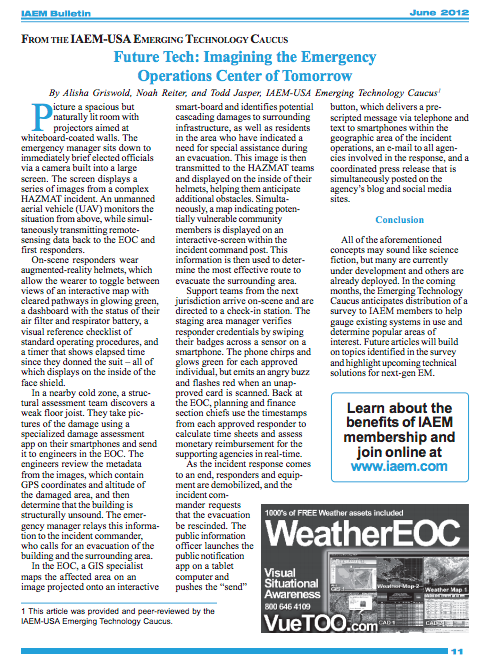
Future Tech: Imagining the Emergency Operations Center of Tomorrow

By Alisha Griswold, Noah Reiter, and Todd Jasper, IAEM-USA Emerging Technology Caucus

Picture a spacious but naturally lit room with projectors aimed at whiteboard-coated walls. The Emergency Manager sits down to immediately brief elected officials via a camera built into a large screen. The screen displays a series of images from a complex HAZMAT incident. An unmanned aerial vehicle (UAV) monitors the situation from above while simultaneously transmitting remote-sensing data back to the EOC and first responders.

On-scene responders wear augmented-reality helmets, which allow the wearer to toggle between views of an interactive map with cleared pathways in glowing green, a dashboard with the status of their air filter and respirator battery, a visual reference checklist of standard operating procedures and a timer that shows elapsed time since they donned the suit, all of which displays on the inside of the face shield

In a nearby cold zone, a structural assessment team discovers a weak floor joist; they take pictures of the damage using a specialized damage assessment app on their smartphones and send it to engineers in the EOC. The engineers review the metadata from the images, which contains GPS coordinates and altitude of the damaged area, and then determine that the building is structurally unsound. The Emergency Manager relays this information to the Incident Commander, who calls for an evacuation of the building and the surrounding area.

In the EOC, a GIS specialist maps the affected area on an image projected onto an interactive smart-board and identifies potential cascading damages to surrounding infrastructure, as well as residents in the area who have indicated a need for special assistance during an evacuation. This image is then transmitted to the HAZMAT teams and displayed on the inside of their helmets, helping them anticipate additional obstacles. Simultaneously, a map indicating potentially vulnerable community members is displayed on an interactive-screen within the Incident Command Post, which is then used to determine the most effective route to evacuate the surrounding area.

Support teams from the next jurisdiction arrive on-scene and are directed to a check-in station. The Staging Area Manager verifies responder credentials by swiping their badges across a sensor on a smartphone. The phone chirps and glows green for each approved individual but emits an angry buzz and flashes red when an unapproved card is scanned.  Back at the EOC, Planning and Finance Section Chiefs use the timestamps from each approved responder to calculate time sheets and assess monetary reimbursement for the supporting agencies in real-time.

As the incident response comes to an end, responders and equipment are demobilized and the Incident Commander requests that the evacuation be rescinded. The Public Information Officer launches the public notification app on a tablet computer and pushes the “send” button, which delivers a pre-scripted message via telephone and text to smartphones within the geographic area of the incident operations, an e-mail to all agencies involved in the response, as well as a coordinated press release that is simultaneously posted on the agency’s blog and social media sites.

Conclusion

All of the aforementioned technologies may sound like fantasy, but many are currently under development and others are already deployed. In the coming months, the Emerging Technology Caucus anticipates distributing a survey to all emergency management agencies to baseline the existing technology in use, as well as to gauge interest in emerging solutions. Future articles will delve deeper into those survey results and some of the technological solutions of tomorrow.

Share this:

  • Email a link to a friend (Opens in new window) Email
  • Share on X (Opens in new window) X
  • Share on Facebook (Opens in new window) Facebook
  • Share on Pinterest (Opens in new window) Pinterest
  • Share on Reddit (Opens in new window) Reddit
Like Loading...

Storm Chasers: Asset or Nuisance?

21 Thursday Jun 2012

Posted by toddjasper in EMERGENCY MANAGEMENT

≈ 1 Comment

Recent articles critical of storm chasers impeding first responders: The Republic, Fox, Salina Journal, and LA Times.

Share this:

  • Email a link to a friend (Opens in new window) Email
  • Share on X (Opens in new window) X
  • Share on Facebook (Opens in new window) Facebook
  • Share on Pinterest (Opens in new window) Pinterest
  • Share on Reddit (Opens in new window) Reddit
Like Loading...

Mitigation Journal Interview: Doomsday Preppers–More Harm than Good

10 Sunday Jun 2012

Posted by toddjasper in EMERGENCY MANAGEMENT

≈ Leave a comment

Recently I had the pleasure of sitting for another chat session with my good friend, Rick Russotti, from Mitigation Journal. We had a great discussion about the validity of the National Geographic show, “Doomsday Preppers”. It’s worth a listen, click here to access the podcast.

Share this:

  • Email a link to a friend (Opens in new window) Email
  • Share on X (Opens in new window) X
  • Share on Facebook (Opens in new window) Facebook
  • Share on Pinterest (Opens in new window) Pinterest
  • Share on Reddit (Opens in new window) Reddit
Like Loading...

CNN: The Brotherhood of Disaster City

05 Tuesday Jun 2012

Posted by toddjasper in EMERGENCY MANAGEMENT

≈ Leave a comment

Disaster City — 52 acres of crumbling buildings, smashed cars and rubble piles — to put first responders’ search and rescue training to the test

Share this:

  • Email a link to a friend (Opens in new window) Email
  • Share on X (Opens in new window) X
  • Share on Facebook (Opens in new window) Facebook
  • Share on Pinterest (Opens in new window) Pinterest
  • Share on Reddit (Opens in new window) Reddit
Like Loading...

Severe Weather: The Difference Between Watch and Warning

02 Saturday Jun 2012

Posted by toddjasper in EMERGENCY MANAGEMENT

≈ 1 Comment

Every month I have an emergency preparedness article in the local newspaper (ChevyChase.Patch.com). Here’s the link to my June article. I’ve also copied it below:

When seconds count, knowing the difference between a watch or a warning can save your life!

 “TORNADO WARNING now in affect for Montgomery County. Residents should seek safe shelter. THIS IS A DANGEROUS AND POSSIBLY LIFE THREATENING SITUATION.” This message was sent last night due to severe thunderstorms capable of producing tornadoes in Chevy Chase.

While the message certainly sounds urgent, most folks still struggle with the differences between watches, warnings, and advisories. However, for an emergency notification to be effective, it must be comprehended.

Below are short descriptions of notifications. Parents might consider teaching their children what these different notifications mean as well. In addition to my descriptions below, the National Weather Service (NWS) has a simple website for explaining each type of notification.

  • Advisories: This type of notification is the least urgent and may occur long before a storm hits. While less urgent than a warning, advisories are still helpful and everyone should pay attention when advisories are distributed.


  • Watch: A watch is a notification for when the risk of hazardous weather or flooding has increased significantly, but its occurrence, location or timing is still uncertain. An easy way to think about this notification is to simply think of a wristwatch–signifying that you still have time before the storm or flooding arrives.


  • Warning: A warning is the most severe and urgent. It is issued when hazardous weather or flood is occurring, imminent or likely. A warning means weather conditions pose a threat to life or property. People in the path of the storm need to take protective action.

Hopefully this primer helps prepare you and your family the next time you hear a weather or flood advisory, watch, or warning.

Todd Jasper is a federal emergency manager and has been happy to call Chevy Chase home since 2008. His emergency management blog is www.toddjasper.com.


Share this:

  • Email a link to a friend (Opens in new window) Email
  • Share on X (Opens in new window) X
  • Share on Facebook (Opens in new window) Facebook
  • Share on Pinterest (Opens in new window) Pinterest
  • Share on Reddit (Opens in new window) Reddit
Like Loading...

Enter your email address to follow this blog and receive notifications of new posts by email.

Join 49 other subscribers

Recent Posts

  • Todd’s Interview: “Questions Raised about Police Response in Capitol Shooting”
  • Todd’s NPR Interview on Tragic Navy Yard Mass Shooting
  • 5 Reasons Your Agency Should Have a Smartphone App
  • FEMA Releases Revised Federal Continuity Directive 2 (FCD-2)
  • Intro to IAEM Emerging Technologies Caucus (ETC)

Todd’s Tweets

Tweets by toddjasper

Categories

  • #SMEM
  • ABOUT TODD
  • CAMPUS SAFETY, SECURITY, & PREPAREDNESS
  • CONTINUITY OF OPERATIONS
  • EMERGENCY MANAGEMENT
  • EMERGENCY NOTIFICATION
  • HOMELAND SECURITY
  • PREPAREDNESS
  • PUBLIC HEALTH
  • RECOVERY
  • RESPONSE

Blog at WordPress.com.

  • Subscribe Subscribed
    • toddjasper
    • Join 49 other subscribers
    • Already have a WordPress.com account? Log in now.
    • toddjasper
    • Subscribe Subscribed
    • Sign up
    • Log in
    • Report this content
    • View site in Reader
    • Manage subscriptions
    • Collapse this bar

Loading Comments...

    %d