• About Todd
  • Best of the Blog
  • Memes
  • Reading List
  • Todd’s Publications

toddjasper

~ Amat victoria curam

toddjasper

Author Archives: toddjasper

The Need for Campus Emergency Planning Scenarios

28 Wednesday Dec 2011

Posted by toddjasper in CAMPUS SAFETY, SECURITY, & PREPAREDNESS, EMERGENCY MANAGEMENT, PREPAREDNESS, RECOVERY, RESPONSE

≈ Leave a comment

In March 2006, the Federal interagency community released its updated fifteen all-hazards planning scenarios entitled the “National Planning Scenarios” or NPS. NPS are planning tools that are representative of the range of potential terrorist attacks and natural disasters and the related impacts that face our nation. The objective of the NPS was to develop a minimum number of credible scenarios in order to establish the range of response requirements to facilitate preparedness planning at the Federal level.
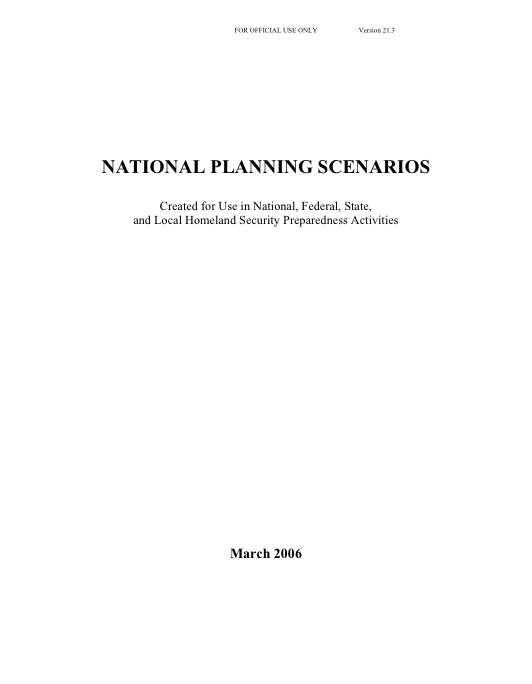
NPS were used in the implementation of Homeland Security Presidential Directive (HSPD)-8, “National Preparedness,” including the development of the National Preparedness Goal and National Exercise Program (NEP). In helping to develop the National Preparedness Goal, NPS provided the foundation for identifying the capabilities across all mission areas and the target levels of those capabilities needed for effective prevention, response, and recovery to major events, such as those outlined in the NPS.

While documents like NPS, the National Preparedness Directive, and National Preparedness Goal constitute the foundation of planning and preparedness for Federal planners, very few foundational documents exist for our Nation’s most vulnerable citizens: our children.

With that in mind, I propose (in draft form) the following Campus Emergency Planning Scenarios (CEPS), sorted by natural hazards and man-made hazards:


In the perfect world, each school would have an Emergency Operations Plan (EOP) with hazard-specific annexes (taken from the aforementioned CEPS). Schools would design and develop plans that include protective measures, pre-scripted public information products, initial actions, coordination requirements, and tactical-level checklists for the incident commander and campus ICS positions.

While many schools may have plans for one or several of the CEPS hazards, few schools have comprehensive emergency management programs that address all of the CEPS hazards. By developing industry-accepted Campus Emergency Planning Scenarios, schools and school districts might be prompted to develop plans, policies, procedures, and protocols for preparing for, responding to, and recovering from the hazards in CEPS. Based on CEPS, perhaps school administrators would be motivated to reach consensus on designing and developing a campus preparedness goal, campus preparedness system/framework, or even lobbying the Secretary of the US Department of Education to release a Campus Preparedness Directive.

As I mentioned earlier in this post, the scenarios I propose are in draft form and I would greatly appreciate any comments, feedback, or suggested changes.

Share this:

  • Email a link to a friend (Opens in new window) Email
  • Share on X (Opens in new window) X
  • Share on Facebook (Opens in new window) Facebook
  • Share on Pinterest (Opens in new window) Pinterest
  • Share on Reddit (Opens in new window) Reddit
Like Loading...

FEMA’s Brand New Bag: The “Whole Community” Strategy

13 Tuesday Dec 2011

Posted by toddjasper in EMERGENCY MANAGEMENT, PREPAREDNESS, RECOVERY, RESPONSE

≈ Leave a comment

As early as July 2010, Craig Fugate, the administrator of FEMA, has been talking about a “whole community” approach at FEMA. During testimony before the U.S. Senate Homeland Security and Governmental Affairs Committee in March 2011, Mr. Fugate explained that the “whole community” approach “recognizes that FEMA is not the nation’s emergency management team – FEMA is only a part of the team.  In order to successfully prepare for, protect against, respond to, recover from, and mitigate all hazards, we must work with the entire emergency management community. This ‘Whole Community’ includes FEMA and our partners at the federal level; our state, local, tribal and territorial governmental partners; non-governmental organizations like faith-based and non-profit groups and private sector industry; and most importantly, individuals, families, and communities, who continue to be our greatest assets and the key to our success.”

Many people (especially FEMA employees and local municipalities) fondly remember “Project Impact: Building Disaster Resilient Communities” introduced by James Lee Witt in 1997. While not exactly the same, it seems that Fugate’s vision of a “whole community” is very much in line with the values and principles evinced by “Project Impact”. A couple of years ago I was in FEMA’s Region III office and I still saw hats and pins for Project Impact!

With the release of the National Disaster Recovery Framework and the promise of forthcoming frameworks for mitigation and preparedness, Mr. Fugate’s time at FEMA has been revolutionary. Under his watch, FEMA has experienced an incredible number of disaster declarations. From 2009 to this current moment, FEMA has been charged with response and recovery operations for 238 disaster declarations. For context, from 1980-1989, FEMA only had 237 disaster declarations! Mr. Fugate’s calm and effective leadership during extraordinary times is not just noteworthy, but is worthy of study for future generations.

Amid talk of a “new, new FEMA” and along with all the progress FEMA and the emergency management field in general has made since Hurricane Katrina, the timing is perfect for Mr. Fugate’s vision of a whole community strategy to motivate a new generation of public servants at all levels (whether they are in the Federal/state/local/tribal government or a community organization/volunteer active in disasters).

Share this:

  • Email a link to a friend (Opens in new window) Email
  • Share on X (Opens in new window) X
  • Share on Facebook (Opens in new window) Facebook
  • Share on Pinterest (Opens in new window) Pinterest
  • Share on Reddit (Opens in new window) Reddit
Like Loading...

Responding to an Outdoor Active Shooter

11 Sunday Dec 2011

Posted by toddjasper in EMERGENCY MANAGEMENT, PREPAREDNESS, RESPONSE

≈ Leave a comment

Read about LAPD’s textbook response to an outdoor active shooter here

Since the Columbine massacre in 1999, many police and sheriff’s departments have trained for rapid responses to indoor active shooters. Fewer have explored the options and training for outdoor active shooters, although the differences between an indoor and outdoor active shooter are significant (and are also different from a sniper attack). I’m not an expert on law enforcement tactics, so I won’t be detailing best practices here. What I am concerned about is the need for additional training for law enforcement and guidance to the public regarding outdoor active shooters.

It’s not a surprise that LAPD responded so well to this most recent outdoor active shooter since the LAPD experienced one of the most notorious outdoor active shooter incidents in 1997 when two heavily-armed bank robbers began an outdoor gun battle with police (see North Hollywood shootout training video Part 1 & 2)

Share this:

  • Email a link to a friend (Opens in new window) Email
  • Share on X (Opens in new window) X
  • Share on Facebook (Opens in new window) Facebook
  • Share on Pinterest (Opens in new window) Pinterest
  • Share on Reddit (Opens in new window) Reddit
Like Loading...

The Economics of Information during Emergencies

09 Friday Dec 2011

Posted by toddjasper in #SMEM, CAMPUS SAFETY, SECURITY, & PREPAREDNESS, EMERGENCY NOTIFICATION

≈ 2 Comments

Unfortunately, the Virginia Tech community suffered another tragedy yesterday with the news of the murder of a police officer and the subsequent suicide of the shooter on campus. Campus officials did their best to communicate with students, faculty, and staff–and I’m aware of no complaints about the campus response. The New York Times has an interesting article regarding the intrepid journalism of VA Tech’s newspaper via Twitter.

As those of us in the Social Media in Emergency Management ( #SMEM ) circle know, Twitter and other forms of social media are quickly becoming major competitors to more established sources for information (such as the NY Times/print media). During emergencies or otherwise notorious events, the Internet can slow to a crawl in the affected area, but Twitter and other forms of SMEM are often unaffected and continue to spread the word. In an emergency, information can be viewed as an economic problem–overwhelming demand with a slow trickle of supply. If that supply is impeded (like VA Tech’s student newspaper–which had to relocate), other pathways to supply are likely to be developed in an ad hoc fashion using mobile technology (namely, social media). Thus, I’ve developed the Jasper model to help visualize the point at which social media overcomes traditional sources of news and guidance during an emergency. Please feel free to leave comments with suggestions, corrections, or modifications to improve this model…

Share this:

  • Email a link to a friend (Opens in new window) Email
  • Share on X (Opens in new window) X
  • Share on Facebook (Opens in new window) Facebook
  • Share on Pinterest (Opens in new window) Pinterest
  • Share on Reddit (Opens in new window) Reddit
Like Loading...

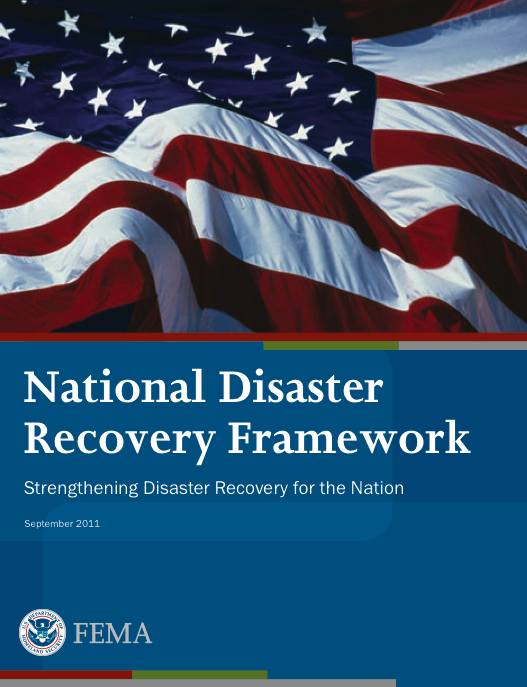
National Disaster Recovery Framework (NDRF)

08 Thursday Dec 2011

Posted by toddjasper in #SMEM, EMERGENCY MANAGEMENT, PREPAREDNESS, RECOVERY

≈ 1 Comment

This evening I took a few minutes to assemble the NDRF page on Wikipedia. It still needs a lot of work, but at least it has some presence now. In my next posts, I’ll be further exploring the new Presidential Policy Directive-8 (PPD-8) regarding National Preparedness (issued March 2011), the National Preparedness Goal (September 2011), the recently released National Preparedness System (November 2011), and the forthcoming National Preparedness Report.

For those who haven’t heard of the NDRF yet, the NDRF was released in September 2011 and is a “sequel” to the National Response  Framework (NRF)–which replaced the National Response Plan. For emergency management geeks like me, the NDRF is a giant step forward in preparing for disasters–at all levels of government AND NGOs. Like the FCO position in response, recovery is led by the Federal Disaster Recovery Coordinator (FDRC). Instead of Emergency Support Functions (ESFs), the NDRF introduces 6 Recovery Support Functions (RSF). What’s really interesting about the NDRF (and this is clearly indicative of Mr. Fugate’s leadership) is that the NDRF includes as much guidance and structure for pre-disaster activities and planning as it does for post-disaster recovery actions. Additionally, the NDRF includes roles and responsibilities for local and state officials–which are meant to work with communities in advance of a disaster or even the need to recovery. This key structural feature of the NDRF effectively transitions some of the coordinating that is normally performed by Federal officials after a disaster to state/local officials BEFORE a disaster.

Share this:

  • Email a link to a friend (Opens in new window) Email
  • Share on X (Opens in new window) X
  • Share on Facebook (Opens in new window) Facebook
  • Share on Pinterest (Opens in new window) Pinterest
  • Share on Reddit (Opens in new window) Reddit
Like Loading...

National Preparedness Month Article

04 Sunday Dec 2011

Posted by toddjasper in ABOUT TODD, PREPAREDNESS

≈ Leave a comment

Just wanted to attach a link to this September 2011 article by Patch.com that I was fortunate to be quoted several times regarding National Preparedness Month and preparing less-resilient populations (including those with functional needs).

Patch Article Are You Prepared 090811

Share this:

  • Email a link to a friend (Opens in new window) Email
  • Share on X (Opens in new window) X
  • Share on Facebook (Opens in new window) Facebook
  • Share on Pinterest (Opens in new window) Pinterest
  • Share on Reddit (Opens in new window) Reddit
Like Loading...

Disaster Mythology

03 Saturday Dec 2011

Posted by toddjasper in EMERGENCY MANAGEMENT, HOMELAND SECURITY, PREPAREDNESS, RECOVERY, RESPONSE

≈ 1 Comment

Over the past few days, I’ve been asking my colleagues (on Twitter and in person) for common disaster myths they’ve encountered. I think I’ll start a series of disaster myth-busting blog posts in which I dissect some of the myths out there in regards to disasters, FEMA, and other organizations active in disasters.

Here is a short list of disaster myths (please feel free to comment to add more!).

  1. Disasters bring out the worst in society (also addressing “mass panic”)
  2. Disaster response and recovery is solely a governmental responsibility
  3. Damages from an improvised nuclear device (IND) are so catastrophic, there’s no use in preparing for it.
  4. Using the “Triangle of Life” concept during an earthquake is safer than the “duck, cover, and hold on” method.
  5. BlackBerry PIN-to-PIN messages are more resilient than other carriers’ SMS or text messages.
  6. Opening windows before a tornado strikes will equalize the pressure inside of the house and prevent more extensive damages or roof failure.
  7. Hiding underneath a highway overpass is a safe location during a tornado.
  8. FEMA will pay for any damages after any disaster
  9. Wireless Priority Service (WPS) / Government Emergency Telephone System (GETS) cards will override any non-prioritized callers.
  10. FEMA is a bloated, bureaucratic agency that is slow to respond and ends up taking over disaster operations from the local-level agencies.
  11. The government will be able to assist me immediately after a disaster.
  12. The US military can always be called in to provide disaster relief.

I’m extremely grateful for the contributions/suggestions by Shannon Buckland, Patrice Cloutier, Bryan Damis, Jim Garrow, Alisha Griswold, R. Kelzenberg, Steven Polunsky, and Rick Russotti.

Share this:

  • Email a link to a friend (Opens in new window) Email
  • Share on X (Opens in new window) X
  • Share on Facebook (Opens in new window) Facebook
  • Share on Pinterest (Opens in new window) Pinterest
  • Share on Reddit (Opens in new window) Reddit
Like Loading...

The Personal Price of Preparedness

30 Wednesday Nov 2011

Posted by toddjasper in EMERGENCY MANAGEMENT, PREPAREDNESS

≈ Leave a comment

Emergency kit suggestions provided by:

I priced out the items recommended by Ready.gov to determine what the minimum price for an emergency kit might be.

Item:

Price:

Buy From:

  • Water, one gallon of water per person per day for at least three days, for drinking and sanitation (need 48 small seal packets of water)
$52 Amazon.com
  • Food, at least a three-day supply of non-perishable food
$6 Amazon.com
  • Battery-powered or hand crank radio and a NOAA Weather Radio with tone alert and extra batteries for both
$30 Amazon.com
  • Waterproof LED flashlight and extra batteries
$8 Amazon.com
  • First aid kit
$20 Amazon.com
  • Whistle to signal for help
$8 Amazon.com
  • Dust mask
$15 Amazon.com
  • Wrench or pliers to turn off utilities
$34 Amazon.com
  • Manual can opener for food
$12 Amazon.com
  • Local maps
$20 Amazon.com
  • Cell phone solar charger
$50 REI.com
  • Sleeping bag
$25 Walmart.com
  • Fire extinguisher
$38 Sears.com
  • Knife
$32 Amazon.com
  • Emergency fire starter
$5 Amazon.com
  • Multi-tool
$40 Amazon.com
  • Chemical light sticks
$10 Amazon.com
TOTAL $405.00

***Important note: this kit does not include a change of clothes, work gloves, cold weather gear, extra cash, prescription medications, or even a bag or Pelican case for holding all these supplies

———————————————————————————————————

The emergency kit that I priced-out above is only for one person and the cost still comes to more than $400! In another post I’ll further explore the cost inequities of emergency preparedness and less-resilient populations. In the interim, it might be best to slowly (and affordably) build your kit.

Share this:

  • Email a link to a friend (Opens in new window) Email
  • Share on X (Opens in new window) X
  • Share on Facebook (Opens in new window) Facebook
  • Share on Pinterest (Opens in new window) Pinterest
  • Share on Reddit (Opens in new window) Reddit
Like Loading...

Hola

29 Tuesday Nov 2011

Posted by toddjasper in ABOUT TODD

≈ Leave a comment

Welcome to my blog! I’ll be mostly focused on emergency management, disaster management, social media in emergency management ( #SMEM ), incident improvisation, disaster informatics, disaster analytics, and continuity of operations.

Share this:

  • Email a link to a friend (Opens in new window) Email
  • Share on X (Opens in new window) X
  • Share on Facebook (Opens in new window) Facebook
  • Share on Pinterest (Opens in new window) Pinterest
  • Share on Reddit (Opens in new window) Reddit
Like Loading...
Newer posts →

Enter your email address to follow this blog and receive notifications of new posts by email.

Join 49 other subscribers

Recent Posts

  • Todd’s Interview: “Questions Raised about Police Response in Capitol Shooting”
  • Todd’s NPR Interview on Tragic Navy Yard Mass Shooting
  • 5 Reasons Your Agency Should Have a Smartphone App
  • FEMA Releases Revised Federal Continuity Directive 2 (FCD-2)
  • Intro to IAEM Emerging Technologies Caucus (ETC)

Todd’s Tweets

Tweets by toddjasper

Categories

  • #SMEM
  • ABOUT TODD
  • CAMPUS SAFETY, SECURITY, & PREPAREDNESS
  • CONTINUITY OF OPERATIONS
  • EMERGENCY MANAGEMENT
  • EMERGENCY NOTIFICATION
  • HOMELAND SECURITY
  • PREPAREDNESS
  • PUBLIC HEALTH
  • RECOVERY
  • RESPONSE

Blog at WordPress.com.

  • Subscribe Subscribed
    • toddjasper
    • Join 49 other subscribers
    • Already have a WordPress.com account? Log in now.
    • toddjasper
    • Subscribe Subscribed
    • Sign up
    • Log in
    • Report this content
    • View site in Reader
    • Manage subscriptions
    • Collapse this bar
 

Loading Comments...
 

    %d