• About Todd
  • Best of the Blog
  • Memes
  • Reading List
  • Todd’s Publications

toddjasper

~ Amat victoria curam

toddjasper

Author Archives: toddjasper

Identifying Technological Gaps in Your Digital Toolbox

07 Monday May 2012

Posted by toddjasper in EMERGENCY MANAGEMENT

≈ Leave a comment

An Excerpt from the May 2012 Bulletin of the
International Association of Emergency Managers (IAEM)
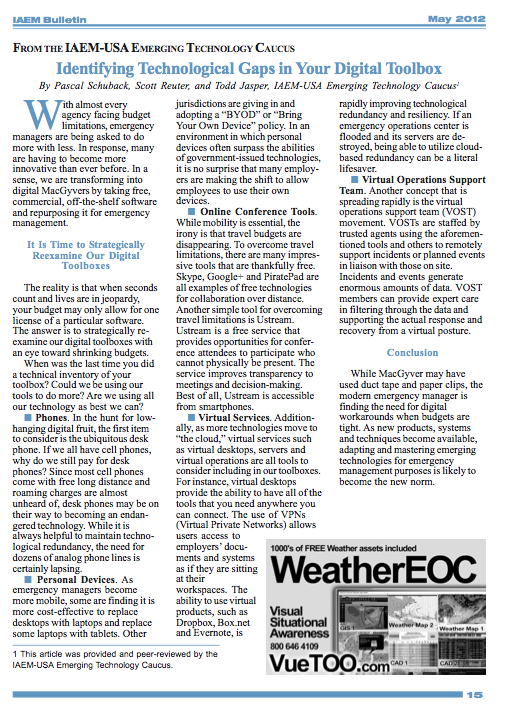
Here’s a plain text version as well:

Identifying Technological Gaps in Your Digital Toolbox
By Pascal Schuback, Scott Reuter, and Todd Jasper, IAEM-USA Emerging Technology Caucus

With almost every agency facing budget limitations, emergency managers being asked to do more with less. In response, many are having to become more innovative than ever before. In a sense, we are transforming into digital MacGuyvers by taking free, commercial-off-the-shelf software and repurposing it for emergency management.

The reality is that when seconds count and lives are in jeopardy, your budget may only allow for one license of a particular software. The answer is to strategically re-examine our digital toolboxes with an eye towards shrinking budgets. When was the last time you did a technical inventory of your toolbox? Could we be using our tools to do more? Are we using all our technology the best we can?

  • PHONES In the hunt for low-hanging digital fruit, the first item to consider is the ubiquitous desk phone. If we all have cell phones, why do we still pay for desk phones? Since most cell phones come with free long distance and roaming charges are almost unheard of, desk phones may be on their way to becoming an endangered technology. While it is always helpful to maintain technological redundancy, the need for dozens of analog phone lines is certainly lapsing.
  • PERSONAL DEVICES As emergency managers become more mobile, some are finding it is more cost-effective to replace desktops with laptops and replace some laptops with tablets. Other jurisdictions are giving in and adopting a “BYOD”, or “Bring Your Own Device” policy. In an environment in which personal devices often surpass the abilities of government-issued technologies, it is no surprise that many employers are making the shift to allow employees to use their own devices.
  • ONLINE CONFERENCE TOOLS While mobility is essential, the irony is that travel budgets are disappearing. To overcome travel limitations, there are many impressive tools that are thankfully free. Skype, Google+, and PiratePad are all examples of free technologies for collaboration over distance. Another simple tool for overcoming travel limitations is Ustream. Ustream is a free service that provides opportunities for conference attendees to participate who cannot physically be present. The service improves transparency to meetings and decision-making. Best of all, Ustream is accessible from smartphones.
  • VIRTUAL SERVICES Additionally, as more technologies move to “the cloud”, virtual services such as virtual desktops, servers and even virtual operations are all tools to consider in our toolboxes.For instance, virtual desktops provide the ability to have all of the tools that you need anywhere you can connect. The use of VPN’s (Virtual Private Networks) allows users access their employer’s documents and systems as if they are sitting at their workspaces. The ability to use virtual products like Dropbox, Box.net and Evernote is rapidly improving technological redundancy and resiliency. If an emergency operations center is flooded and its servers are destroyed, being able to utilize cloud-based redundancy can be a literal lifesaver.
  • VIRTUAL OPERATIONS SUPPORT TEAM Another concept that is spreading rapidly is the virtual operations support team (VOST) movement. VOSTs are staffed by trusted agents using the aforementioned tools and others to remotely support incidents or planned events in liaison with those on site. Incidents and events generate enormous amounts of data. VOST members can provide expert care in filtering through the data and supporting the actual response and recovery from a virtual posture..

CONCLUSION
While MacGyver may have used duct tape and paper clips, the modern emergency manager is finding the need for digital workarounds when budgets are tight. As new products, systems and techniques become available, adapting and mastering emerging technologies for emergency management purposes is likely to become the new norm.

Share this:

  • Email a link to a friend (Opens in new window) Email
  • Share on X (Opens in new window) X
  • Share on Facebook (Opens in new window) Facebook
  • Share on Pinterest (Opens in new window) Pinterest
  • Share on Reddit (Opens in new window) Reddit
Like Loading...

National Preparedness Report Released

03 Thursday May 2012

Posted by toddjasper in EMERGENCY MANAGEMENT

≈ Leave a comment

PPD 8, National Preparedness Report

Today, FEMA released the National Preparedness Report (although it is dated March 30, 2012). Nothing too intense, but good to know we’re all on the same page!

Main points:

  • As the NPR coordinator, FEMA worked with the full range of whole community partners—including all levels of government, private and nonprofit sectors, faith-based organizations, communities, and individuals—to develop the NPR
  • FEMA integrated data from the 2011 State Preparedness Reports (SPRs), statewide self- assessments of core capability levels submitted by all 56 U.S. states and territories through a standardized survey.
  • Areas of overall national strength: planning, operational coordination, intelligence and information sharing, environmental response/health and safety, mass search and rescue operations, operational communications, public health and medical services
  • These areas of national strength align closely with the Goal’s cross-cutting, common capabilities and those capabilities from the Goal’s Response mission area.
  • Cybersecurity and recovery-focused core capabilities are national areas for improvement.
  • Good to hear: “Key finding: Federal preparedness assistance programs have helped build and enhance state, local, tribal, and territorial capabilities through multi-year investments across mission areas.”
  • Great: “Key Finding: States generally reported the most progress in capabilities that they identified as high priorities.”
  • The Nation has made demonstrable progress addressing areas for improvement identified after events such as 9/11 and Hurricane Katrina. 
  • FEMA recognizes the need to better support folks with special needs… “Efforts to integrate people with disabilities and other access and functional needs, children, pregnant women, older adults, and people with chronic medical conditions into preparedness activities require attention across all mission areas. “
  • Good to hear: “Key finding: Decision-makers in the public and private sectors increasingly are using risk analysis to shape and prioritize preparedness activities across mission areas.”
  • Pretty interesting as the final “key finding”: “Key finding: Many programs exist to build and sustain capabilities across all mission areas, but challenges remain in measuring progress from year to year.”
  • Excerpted conclusion:The complex set of threats and hazards facing the Nation and the underlying interdependencies within critical infrastructure and supply chains require integrated preparedness efforts to build, sustain, and deliver the core capabilities. The components of the National Preparedness System will provide a consistent and reliable approach to support decision-making, resource allocation, and ongoing performance assessment.

Share this:

  • Email a link to a friend (Opens in new window) Email
  • Share on X (Opens in new window) X
  • Share on Facebook (Opens in new window) Facebook
  • Share on Pinterest (Opens in new window) Pinterest
  • Share on Reddit (Opens in new window) Reddit
Like Loading...

Five Lessons for Increasing the Efficacy of Emergency Notification

14 Saturday Apr 2012

Posted by toddjasper in EMERGENCY MANAGEMENT

≈ 1 Comment

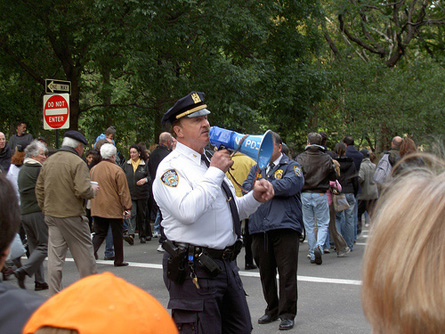
NYPD Inspector John Codiglia and his megaphone at work

Efficacy is the power to produce effect and the concept is especially important for emergency messaging. With emergency notification and warning, the desire of the sender is to empower and embolden the recipient with information, directions, and guidance in order to produce an effect.

With the proliferation of mass messaging systems capable of sending thousands of text messages, emails, and phone calls per minute, many jurisdictions and agencies have invested significant budget, time, and effort into procuring and installing these systems. While many agencies and jurisdictions have trained their staff on how to use mass messaging systems to send a message, few have provided training on what to say and how to say it.

Below are a few quick lessons on how to increase the efficacy of your emergency messages:

Lesson #1: Speed Can Trump Accuracy during Emergencies
The Virginia Tech massacre taught us how important it is to send emergency notification quickly following an act of violence or incident. As the Department of Education reported, “Because Virginia Tech failed to notify its students and staff of the initial shootings on a timely basis, thousands continued to travel on campus, without a warning of the events at the residence hall.”

On the day of the shooting, VA Tech sent an urgent email saying “A gunman is loose on campus. Stay in buildings until further notice. Stay away from all windows.” By the time that email reached students, all of the gunman’s victims had been already shot. Clearly, speed is important in providing warning. The problem is that emergency messages and warnings are inherently different to craft, especially in the middle of a hectic or stressful situation. Therefore, I recommend that all jurisdictions and agencies develop emergency notification protocols including pre-scripted (or “canned”) message templates.

As a lesson learned post-VA Tech, St. John’s University in New York had an incident of a male carrying a gun on campus. The University issued a text alert. Their text message was sent soon after the first report of the gunman: “From public safety. Male was found on campus with a rifle. Please stay in your buildings until further notice. He is in custody, but please wait until the all-clear.” According to the Associated Press, “At St. John’s, the [text] ‘messages were sent so quickly that a student who helped subdue the suspect felt his cell phone vibrate with the information while he was restraining the gunman’”.

Lesson #2: Don’t Say Please and Thank You
Emergency text messages should not be overly friendly. In the St. John’s University example, the school used the word ‘please’ twice. Using polite language such as please and thank you may sound appealing, but it can also send the wrong message. Recipients should feel instructed and compelled to follow instruction. Asking recipients to ‘please’ do something can sometimes imply that the instruction is optional. For the urgent situations requiring emergency text messaging, there can be no misunderstanding that instructions are not optional.

Lesson #3: When to Use Jargon…
Emergency managers should refrain from using institutional jargon. “Shelter-in-place” is appropriate guidance if the school has trained all students in shelter-in-place procedures and the phrase is understood. If the population receiving guidance is not familiar with emergency management jargon, it is more helpful to ask for students to simply stay indoors rather than add to confusion with institutional jargon. A message to go into lock-down may not be understood or followed as well as a message instructing students to close and lock windows and doors and await further instruction.

Lesson #4: Avoid Emotive Language
Emotive language is language that conveys emotion. When describing the incident in an emergency message, do not make unfounded conclusions or use emotive words. For example, “Explosion on campus” is more acceptable than “Terrorism strikes home”, the former explains more and assumes less. It is not necessary or helpful to send alerts theorizing as to whether an incident is a terrorist plot or an accident or otherwise. Sending a message with the notice “this incident does not appear to be terrorism at this time” takes up precious space in an emergency message that may be only read quickly under stress by the recipient. It is always more helpful to issue guidance rather than speculation.

Lesson #5: Include Guidance and Instruction with Every Emergency Message
In response to the outcry by parents and students after the Virginia Tech shooting, some emergency managers or school administrators may be inclined to think of emergency messages as a panacea: simply issue a emergency text message and absolve the school of potential backlash from a mishandled incident. The alert system must not be used to gradually shift the responsibility of handing an incident onto those affected by the incident. In other words, just because recipients are aware of an incident, does not enable them to become their own emergency managers, able to adequately judge risk and protect themselves in the proper fashion. Alerts should be viewed as a tool and as a means to an end, not an end itself. As part of a comprehensive emergency management system, emergency alerts should be used in conjunction with shelter-in-place and evacuation training and drills, so that when incidents occur, the community is able to respond confidently.

While the five lessons above are helpful, agencies and jurisdictions need to invest in developing emergency notification protocols specific to their intended audience. Being sensitive to the age, socioeconomic, ethnic, and educational backgrounds of the intended audience can have an impact of how well the message is understood and whether the message achieves its desired result. While emergency notification systems are clearly a useful tool, it must be used discriminatingly and with great forethought. When seconds count and lives are in danger, the right information communicated in the  proper manner can make the difference between life and death.


Share this:

  • Email a link to a friend (Opens in new window) Email
  • Share on X (Opens in new window) X
  • Share on Facebook (Opens in new window) Facebook
  • Share on Pinterest (Opens in new window) Pinterest
  • Share on Reddit (Opens in new window) Reddit
Like Loading...

Video

National Weather Service Amps Up Attention-Grabbing Storm Descriptions

09 Monday Apr 2012

Posted by toddjasper in EMERGENCY MANAGEMENT

≈ 1 Comment

Share this:

  • Email a link to a friend (Opens in new window) Email
  • Share on X (Opens in new window) X
  • Share on Facebook (Opens in new window) Facebook
  • Share on Pinterest (Opens in new window) Pinterest
  • Share on Reddit (Opens in new window) Reddit
Like Loading...

A Primer in #SMEM

03 Tuesday Apr 2012

Posted by toddjasper in EMERGENCY MANAGEMENT

≈ Leave a comment

An Excerpt from the April 2012 Online Bulletin of the
International Association of Emergency Managers (IAEM)

Here’s a plain text version as well:

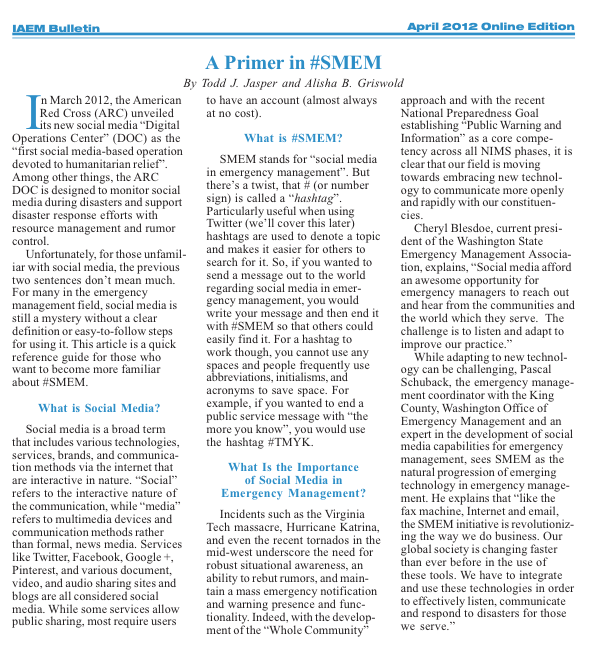
A Primer in #SMEM
By Todd J. Jasper and Alisha B. Griswold

In March 2012, the American Red Cross (ARC) unveiled its new social media “Digital Operations Center” (DOC) as the “first social media-based operation devoted to humanitarian relief”. Among other things, the ARC DOC is designed to monitor social media during disasters and support disaster response efforts with resource management and rumor control.

Unfortunately, for those unfamil- iar with social media, the previous two sentences don’t mean much. For many in the emergency management field, social media is still a mystery without a clear definition or easy-to-follow steps for using it. This article is a quick reference guide for those who want to become more familiar about #SMEM.

What is Social Media?

Social media is a broad term that includes various technologies, services, brands, and communica- tion methods via the internet that are interactive in nature. “Social” refers to the interactive nature of the communication, while “media” refers to multimedia devices and communication methods rather than formal, news media. Services like Twitter, Facebook, Google +, Pinterest, and various document, video, and audio sharing sites and blogs are all considered social media. While some services allow public sharing, most require users to have an account (almost always at no cost).

What is #SMEM?

SMEM stands for “social media in emergency management”. But there’s a twist, that # (or number sign) is called a “hashtag”. Particularly useful when using Twitter (we’ll cover this later) hashtags are used to denote a topic and makes it easier for others to search for it. So, if you wanted to send a message out to the world regarding social media in emer- gency management, you would write your message and then end it with #SMEM so that others could easily find it. For a hashtag to work though, you cannot use any spaces and people frequently use abbreviations, initialisms, and acronyms to save space. For example, if you wanted to end a public service message with “the more you know”, you would use the hashtag #TMYK.

What Is the Importance of Social Media in Emergency Management?

Incidents such as the Virginia Tech massacre, Hurricane Katrina, and even the recent tornados in the mid-west underscore the need for robust situational awareness, an ability to rebut rumors, and main- tain a mass emergency notification and warning presence and functionality. Indeed, with the develop- ment of the “Whole Community” approach and with the recent National Preparedness Goal establishing “Public Warning and Information” as a core competency across all NIMS phases, it is clear that our field is moving towards embracing new technology to communicate more openly and rapidly with our constituencies.

Cheryl Blesdoe, current president of the Washington State Emergency Management Association, explains, “Social media afford an awesome opportunity for emergency managers to reach out and hear from the communities and the world which they serve. The challenge is to listen and adapt to improve our practice.”

While adapting to new technology can be challenging, Pascal Schuback, the emergency management coordinator with the King County, Washington Office of Emergency Management and an expert in the development of social media capabilities for emergency management, sees SMEM as the natural progression of emerging technology in emergency management. He explains that “like the fax machine, Internet and email, the SMEM initiative is revolutioniz- ing the way we do business. Our global society is changing faster than ever before in the use of these tools. We have to integrate and use these technologies in order to effectively listen, communicate and respond to disasters for those we serve.”

Share this:

  • Email a link to a friend (Opens in new window) Email
  • Share on X (Opens in new window) X
  • Share on Facebook (Opens in new window) Facebook
  • Share on Pinterest (Opens in new window) Pinterest
  • Share on Reddit (Opens in new window) Reddit
Like Loading...

Happy Birthday FEMA!

01 Sunday Apr 2012

Posted by toddjasper in EMERGENCY MANAGEMENT

≈ Leave a comment

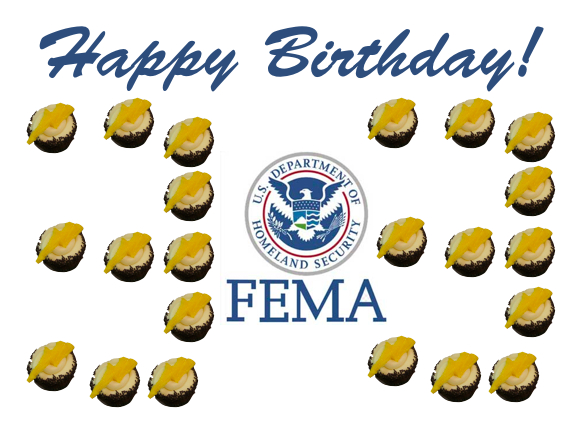
Today FEMA turns 33! What better way to celebrate than with some lightning bolt cupcakes?

Effective April 1, 1979, FEMA was created by President Jimmy Carter with the release of Executive Order 12127, which “merged many of the separate disaster-related responsibilities into the Federal Emergency Management Agency (FEMA). Among other agencies, FEMA absorbed: the Federal Insurance Administration, the National Fire Prevention and Control Administration, the National Weather Service Community Preparedness Program, the Federal Preparedness Agency of the General Services Administration and the Federal Disaster Assistance Administration activities from HUD. Civil defense responsibilities were also transferred to the new agency from the Defense Department’s Defense Civil Preparedness Agency”- (from FEMA’s history page).

As a young agency, FEMA has not only deployed to hundreds of disaster declarations, but has had to re-design its approach and methodologies several times along the way. Now, under the leadership of Administrator Fugate, FEMA seems more committed than ever to progressing emergency management doctrine in the United States–not just for the Feds, but for all levels of government. I’m really looking forward to many of the new developments. It’s an exciting time to be an emergency manager.

Share this:

  • Email a link to a friend (Opens in new window) Email
  • Share on X (Opens in new window) X
  • Share on Facebook (Opens in new window) Facebook
  • Share on Pinterest (Opens in new window) Pinterest
  • Share on Reddit (Opens in new window) Reddit
Like Loading...

5 Easy Emergency Preparedness Tips for Apartment Dwellers

01 Sunday Apr 2012

Posted by toddjasper in EMERGENCY MANAGEMENT

≈ Leave a comment

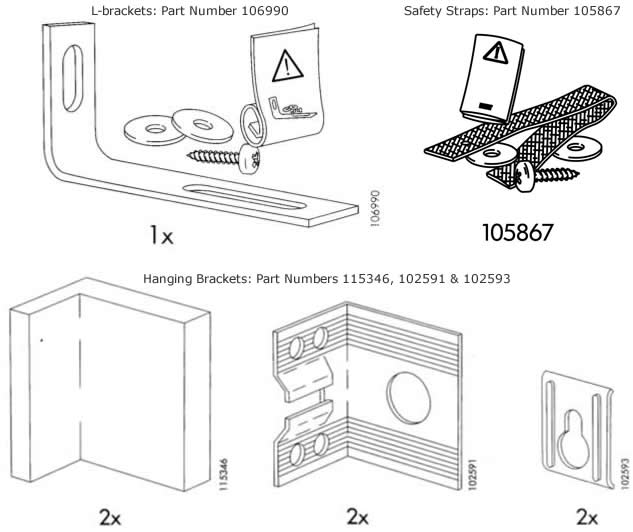
5. Strap and/or Secure Heavy Furniture to the Wall

Oftentimes, apartment buildings are taller than single family dwellings–which can result in more noticeable swaying at higher floors during an earthquake. By securing bookcases, filing cabinets, televisions, and other heavy items to the wall, you can decrease the risk of falling objects and subsequent injury.

4. Learn How to Turn Off Gas and Electricity in Your Apartment

A survey conducted by the Tokyo Fire Department after the Great East Japan Earthquake on March 11, 2011 found that furniture and electrical appliances fell over in nearly half of the Tokyo apartments located 11 floors up or higher. In the US, many apartments have natural gas appliances. Learning how to turn off the utilities can prevent fires and damage following a disaster. Each apartment is different though, so check with your landlord to determine how to shutoff your utilities after a disaster.

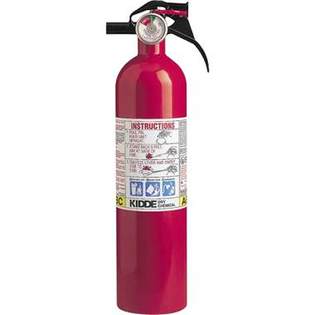
3. Keep an Extra Fire Extinguisher in a Room Other than the Kitchen

Most apartments have relatively small kitchens with a stove near the entryway. If most folks keep a fire extinguisher under the sink, the occupant might not be able to reach under the sink if the fire prohibits entry into the kitchen. Thus, it might be helpful to store an extra fire extinguisher outside of the kitchen to put out stove fires.

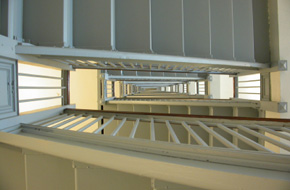
2. Learn the Location of Stairwells

In high-rise apartment buildings, most folks take the elevator. In an emergency though, the best method of egress might be the stairwell. More than half of occupants of World Trade Center 1 & 2 reported that they had never used a stairwell in WTC before 9/11 (NIST Report: NCSTAR-17, Federal Building and Fire Safety Investigation of the World Trade Center Disaster: Occupant Behavior, Egress, and Emergency Communications). Make sure to familiarize yourself with the location of ALL stairwells in your apartment building.

1. Natural Gas Alarm

Late last year, the pilot light in my apartment’s oven went out and natural gas filled our apartment. We detected the odor of natural gas, called the fire department, and evacuated immediately. While it’s pretty common for homes to have CO2 detectors, many folks haven’t heard of natural gas detectors (Sears link here) and may have neglected to purchase a detector. The detectors usually cost less than $50 and could save your life! NIH has a great website on natural gas detectors here.

Share this:

  • Email a link to a friend (Opens in new window) Email
  • Share on X (Opens in new window) X
  • Share on Facebook (Opens in new window) Facebook
  • Share on Pinterest (Opens in new window) Pinterest
  • Share on Reddit (Opens in new window) Reddit
Like Loading...

Planning for an Emerging Danger: Latent Radioactive Material in Household Products

29 Thursday Mar 2012

Posted by toddjasper in EMERGENCY MANAGEMENT

≈ Leave a comment

Two years ago, Rajendra Yadav was working at a scrap metal site in New Delhi, India breaking apart discarded metal appliances, car parts, and other electronics. As he used his hammer to disassemble a large machine, he noticed a shiny glimmer of metal unlike he’d ever seen before. It was small enough to put in his pocket before moving on to the next machine. As he finished work that day, he was shocked to discover burns on his hips and thighs. He died 20 days later.

It turns out that the device Mr. Yadav was hammering was an x-ray machine from Delhi University that was accidentally thrown out with the normal garbage. The shiny metal he placed in his pocket was highly radioactive and resulted in his death. Mr. Yadav’s sickness and death highlighted the threat of radioactive materials in scrap metal. But what if he hadn’t noticed the shiny metal? What if the machine was disassembled and, due to luck and shielding, the workers were not injured or alerted to the fact that there was radiation coming off of the scrap metal?

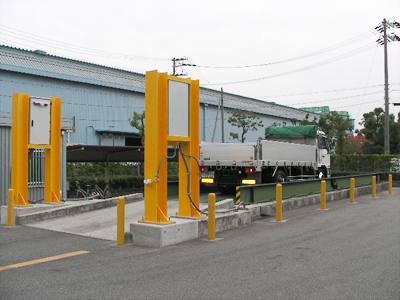
Example of radiation detector for freight trucks

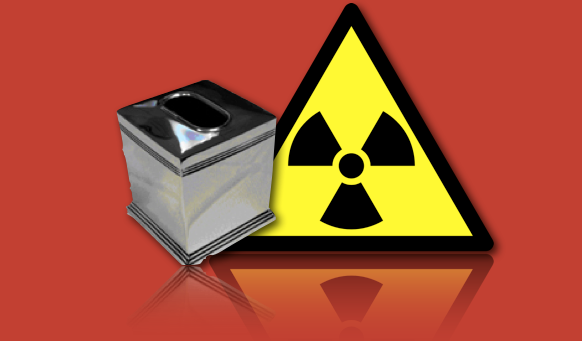
The answer is that the scrap metal would have been melted and used to create new products–like shiny metal tissue box holders.

In January of this year, the retailer Bed, Bath, & Beyond received a shipment of tissue box holders. They shipped some to brick-and-mortar stores and placed the rest for sale on their website. Some of the boxes were placed on a freight truck that was stopped at a truck scale in California when the radiation sensors sounded. This time it wasn’t a false alarm, the tissue boxes were contaminated with cobalt-60 and were definitely radioactive. Somehow, the radiation was not detected by US Customs and Border Protection at the port before it entered the US and, even worse, the product was already for sale at other stores.

Bed, Bath, & Beyond was quickly notified of the incident and began cooperating with the US Nuclear Regulatory Commission (NRC). The NRC usually has authority over nuclear/radioactive material licensees, but clearly Bed, Bath, & Beyond is not a traditional carrier of radioactive material. The retailer has been praised by the NRC for its transparent and full cooperation resulting in the proper removal and disposal of the tissue boxes. Since several tissue boxes were sold to consumers, the retailer has posted notices recalling the item.

In this case, the system worked–not at first inspection at the port, but nevertheless the radiation was detected. By design, we use redundancy to reduce risk. When the shipment evaded detection at the port, it was a truck scale in California that detected the anomaly.

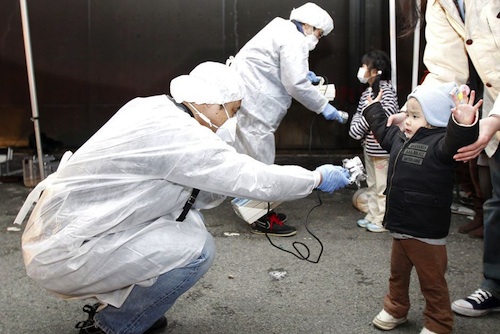
Child screened for radiation after failure at Fukushima nuclear power generating station

Incidents in other countries show us how disastrous radiation can be when it goes undetected, such as the 1987 Goiânia accident in Brazil or the Taiwanese apartment buildings constructed using radioactive rebar in 1982. In Brazil, children played with, ate, and inhaled a glowing blue substance that later was determined to be highly radioactive cesium chloride taken from a medical facility that was being demolished. In Taiwan, several apartment buildings were constructed using rebar that was contaminated with radioactive medical waste. As the article linked above explains, “Eighty-nine of the 4,100 samples were diagnosed with cancer, including cervical cancer, breast cancer, liver cancer, leukemia and thyroid cancer. Researchers said that high incidence of the disease might be attributed to chronic low-dose radiation exposure. Over the course of the research period, 39 of the 89 cancer sufferers died.”

Radiation is inherently worrisome since it is odorless, invisible, and potentially lethal. While the US has a sophisticated, layered system to prevent the transport and distribution of unapproved radioactive materials, emergency managers and public health planners at the local level may need to ask themselves what courses of action are available to them if radiation was discovered in their municipality. While many agencies plan for a radiological dispersal device (RDD), or “dirty bomb”, the concept that a radiological emergency might develop slowly due to the discovery of latent radiation (in other words, radiation that piggybacks on household products or construction material due to contamination at the foundry or assembly facility) is a fairly new concept.

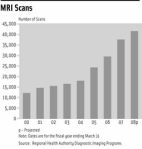
With the increase in use of nuclear medicine (the graph on the left shows the MRI scans per year in Canada, the US has even more), the amount of radioactive material required for nuclear medicine as well as the amount of radioactive material for disposal increases every year. The need to safeguard radioactive material and prepare for discoveries of radiation (latent or intentional) is more important than ever. A good example of the need to be prepared for unexpected radiological incidents is the “radioactive boy scout” who built his own reactor in his parents’ backyard shed in Michigan–only to have his dreams ruined when the EPA, DoE, FBI, NRC, and other Federal and local law enforcement and public health agencies raided his home.

I encourage all emergency managers and public heath planners to re-examine their radiological emergency response and recovery plans to ensure a confident and knowledgeable response/recovery not just to a RDD, but to all types of radiation and nuclear medicine-related contingencies. Then, we must ask ourselves, when was the last time we exercised these plans to make sure we have the capabilities, coordinating agencies/partners, tools, policy, protocols, procedures, and pre-scripted public information and warning required for an incident of this type?

Share this:

  • Email a link to a friend (Opens in new window) Email
  • Share on X (Opens in new window) X
  • Share on Facebook (Opens in new window) Facebook
  • Share on Pinterest (Opens in new window) Pinterest
  • Share on Reddit (Opens in new window) Reddit
Like Loading...

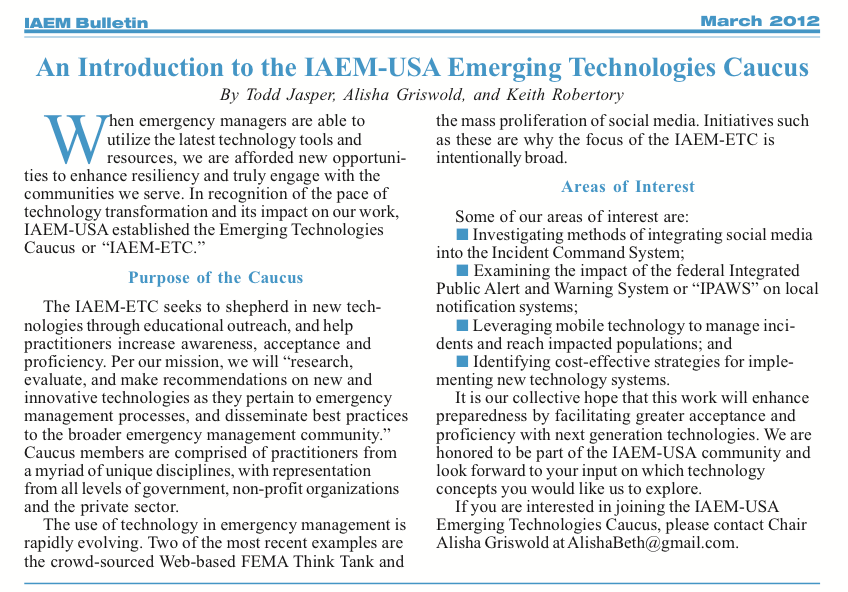
An Introduction to the IAEM-USA Emerging Technologies Caucus

25 Sunday Mar 2012

Posted by toddjasper in EMERGENCY MANAGEMENT

≈ Leave a comment

An Excerpt from the March 2012 Bulletin of the
International Association of Emergency Managers (IAEM)

Share this:

  • Email a link to a friend (Opens in new window) Email
  • Share on X (Opens in new window) X
  • Share on Facebook (Opens in new window) Facebook
  • Share on Pinterest (Opens in new window) Pinterest
  • Share on Reddit (Opens in new window) Reddit
Like Loading...

Doomsday Preppers: Social Fear and Loathing & Threat to Legitimate Preparedness

25 Sunday Mar 2012

Posted by toddjasper in EMERGENCY MANAGEMENT

≈ 3 Comments

Tags

community resiliency, doomsday preppers, yellowstone super volcano

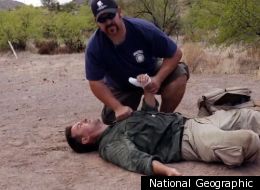
While National Geographic’s cameras rolled, Tim Ralston showed off his arsenal of survival weapons in the Arizona desert. As he demonstrated shooting one of his rifles, he carelessly slipped his thumb in front of the barrel and pulled the trigger resulting in a devastating wound and necessitating his evacuation by helicopter to a trauma center.

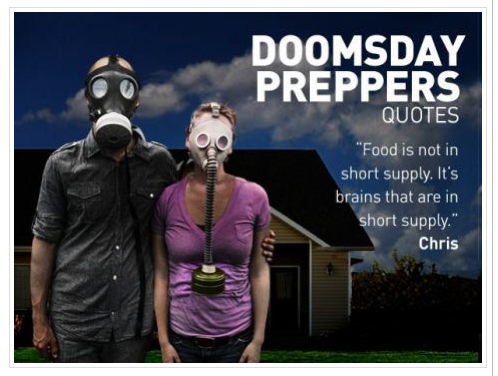
Mr. Ralston is a star of the new reality TV series on National Geographic called “Doomsday Preppers”–a show dedicated to the profound paranoia, hysteria, and insolence of folks convinced that the end of the world and society is near. From the couple who doesn’t drink but insists on stockpiling whiskey, rum, and vodka (for trading and bartering after the currency collapses) to the New York City firefighter fearful of the Yellowstone super-volcano and the potential for knife fights after society collapses, all the individuals and families featured on the show display the worst traits of disaster preparedness.

While citizens, the private sector, and jurisdictions at all levels are embracing the Whole Community approach in order to minimize damages and increase community resiliency in the face of any disaster, the folks featured on Doomsday Preppers seem to have dismissed the notion entirely that community resiliency is a worthy goal.

Instead, the doomsday preppers focus their efforts on devising methods to isolate themselves from the world. Not only do they come across as paranoid misanthropes, the doomsday preppers are uniquely anti-social. As the firefighter in New York City explains, it’s difficult for him to lawfully own firearms in the city, so he’s settled for maintaining an extensive knife collection and paying for private tutoring sessions from edged weapons instructors. His goal is to learn how to use his knives to stab intruders who would threaten his 90-day storage of food. Besides the knives, the firefighter also keeps a box of broken glass by the door to his apartment (that he shares with his wife and two young children) that he plans to scatter in the hallway in an emergency–both to serve as a warning for and impediment to intruders.

For me, the philosophy behind these doomsday preppers is misguided. While individual preparedness is crucial, the doomsday preppers are not simply preparing as a member of the community, but as exclusions of the community. They conscientiously reject pre-disaster societal norms and substitute it with their anticipated version of post-disaster utopia: a society framed on stand-your-ground and shoot-first vigilantism and fanaticism, which is inherently dangerous.

Rather than investing so much budget and effort into weaponry, I’d much rather see the folks featured on Doomsday Preppers become leaders in their community, working with the elderly and those with access and functional needs to prepare resilient plans during a disaster. While the series shows knife-fighting scenes and rifle practice, I came away asking myself “where was the CPR and AED training?” and “why isn’t Community Emergency Response Team (CERT) training mentioned?”.

Political fanaticism masquerading as disaster preparedness challenges legitimate forms of community resiliency and disaster preparedness. Planning and preparing for disasters as a community is a patriotic duty. Ensuring that a post-disaster America continues to be the land of freedom with an enduring form of constitutional government in the face of all types of disasters is patriotic too.

Unfortunately there’s no television show for the emergency managers, public servants, volunteers, community organizers, public health planners, and countless others that work thanklessly to help our communities strengthen in resiliency, planning, readiness, and preparedness.

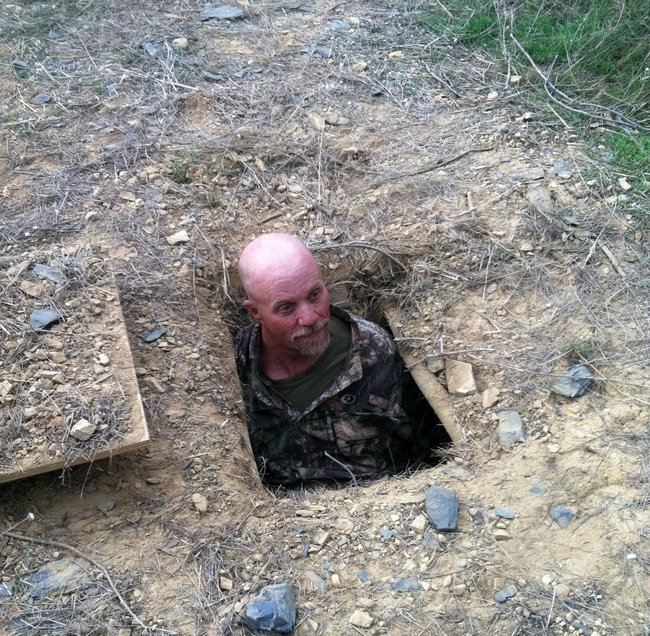
In the end, it’s not the isolated and paranoid survivalists that define disaster preparedness, but those dedicated to strengthening our communities, helping the frail, supporting the sick and injured, and fostering a climate of resiliency and helpful coordination that are the role models for future generations of preppers. While the isolationists literally prepare their holes in the ground and shoot their hands off in the hopes of outmaneuvering the rest of humanity, those of us who answer the selfless call of duty for preserving and improving our communities will continue our efforts to organize and strengthen in productive and positive ways.

Share this:

  • Email a link to a friend (Opens in new window) Email
  • Share on X (Opens in new window) X
  • Share on Facebook (Opens in new window) Facebook
  • Share on Pinterest (Opens in new window) Pinterest
  • Share on Reddit (Opens in new window) Reddit
Like Loading...
← Older posts
Newer posts →

Enter your email address to follow this blog and receive notifications of new posts by email.

Join 49 other subscribers

Recent Posts

  • Todd’s Interview: “Questions Raised about Police Response in Capitol Shooting”
  • Todd’s NPR Interview on Tragic Navy Yard Mass Shooting
  • 5 Reasons Your Agency Should Have a Smartphone App
  • FEMA Releases Revised Federal Continuity Directive 2 (FCD-2)
  • Intro to IAEM Emerging Technologies Caucus (ETC)

Todd’s Tweets

Tweets by toddjasper

Categories

  • #SMEM
  • ABOUT TODD
  • CAMPUS SAFETY, SECURITY, & PREPAREDNESS
  • CONTINUITY OF OPERATIONS
  • EMERGENCY MANAGEMENT
  • EMERGENCY NOTIFICATION
  • HOMELAND SECURITY
  • PREPAREDNESS
  • PUBLIC HEALTH
  • RECOVERY
  • RESPONSE

Blog at WordPress.com.

  • Subscribe Subscribed
    • toddjasper
    • Join 49 other subscribers
    • Already have a WordPress.com account? Log in now.
    • toddjasper
    • Subscribe Subscribed
    • Sign up
    • Log in
    • Report this content
    • View site in Reader
    • Manage subscriptions
    • Collapse this bar
 

Loading Comments...
 

    %d