• About Todd
  • Best of the Blog
  • Memes
  • Reading List
  • Todd’s Publications

toddjasper

~ Amat victoria curam

toddjasper

Category Archives: EMERGENCY MANAGEMENT

Got Kits?

13 Tuesday Mar 2012

Posted by toddjasper in EMERGENCY MANAGEMENT

≈ 1 Comment

FEMA and Ready.gov have done a great job with the Get a Kit, Make a Plan, Be Informed campaign–although I do wish they changed kit to plural, as in “Get Kits”. The need for multiple kits–and setting that expectation upfront–is simple. In addition to a substantial kit at home, most folks need small kits for their office and car that consist of a change of clothes, extra medication, some money, a little food/water, flashlight, and other essentials for a quick shelter-in-place or a short-term evacuation.

Below are examples of other kits you might need as well.

Kit of Last Resort
If you live in an area that experiences wildfires, floods, hurricanes, tsunami, volcanoes, or other hazard that comes with some forewarning and requires an evacuation from your home, you may need to develop an evacuation kit that is a little different than the run-of-the-mill emergency kit. This kit, which I lovingly call a “kit of last resort”, includes items that you might need/want if you have reason to believe your home won’t be there when you come back. The idea behind this kit is that you’re not just planning to take items for survival, but vital records, a few items of nostalgia (such as pictures, heirlooms, etc), and items that you don’t want to lose permanently (such as jewelry, laptop/harddrives/electronic media, etc). Clearly, the mode of transportation you have will influence what you can take (since a Hummer has a different cargo capacity than a unicycle). In this kit, you might be able to pack a lot more clothing and take items that you might not normally consider for a smaller kit. When I think of applications for this kind of kit/collection, I remember when I was growing up in California and wildfires would approach a community, there was always a live shot of folks hastily packing their cars in response to a mandatory evacuation order. The absolute last minute is not the best time to determine what you absolutely need to take with you.

Tornado Shelter Kit
For those that live in areas that experience tornadic activity and must relocate to a community shelter during tornado warnings, it may be best to have a separate kit specifically for sheltering from a tornado.
Potential items to include:

  • Small amounts of food/water
  • Medication and small first aid kit
  • Work clothing/personal protective equipment (like sturdy boots, gloves, eye protection) in case your home is damaged when you return to it.
  • Vital records (in case your home is damaged/destroyed. Vital records should include insurance documentation, financial information, identification)
  • Cell phone charger (if possible, a hand-crank or solar charger as well)
  • LED flashlight and glow sticks
  • Tools/multi-tool to turn off utilities
  • Camera (to document damage)
  • Small personal address book with phone numbers/addresses you can call (both to let loved ones know that you’re ok, but also if you need to arrange shelter/lodging)
  • If you have jewelry/cash that you don’t want to lose, then the safest spot may be with you in a locked pouch.

What’s in your kit and what other hazard-specific kits might be helpful? Feel free to leave comments with other items you recommend including in your emergency/evacuation kit!
Share this:

  • Email a link to a friend (Opens in new window) Email
  • Share on X (Opens in new window) X
  • Share on Facebook (Opens in new window) Facebook
  • Share on Pinterest (Opens in new window) Pinterest
  • Share on Reddit (Opens in new window) Reddit
Like Loading...

Learning from the Deadly MGM Grand Fire: The Next Step in Evacuation Preparedness

11 Sunday Mar 2012

Posted by toddjasper in EMERGENCY MANAGEMENT

≈ 2 Comments

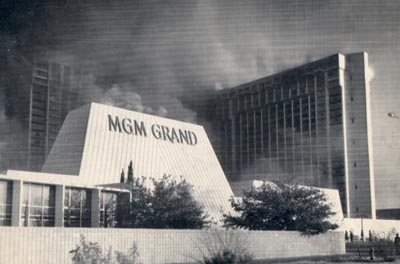
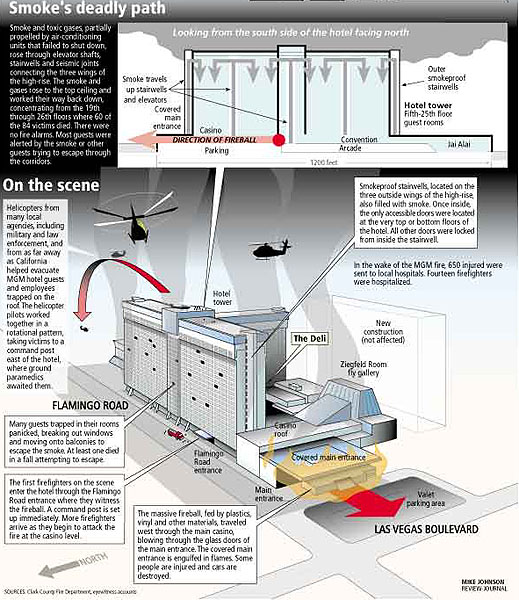
Over 30 years ago, the deadliest blaze in Las Vegas history ignited at the MGM Grand Casino and Hotel. The hotel was built without fire sprinklers (except in the cash-counting room), had manual fire alarms only, and many design defects (including in the elevators, ceiling tiles, and a ventilation system that was improperly installed–which led to deadly smoke infiltrating the entire building). As a local newspaper reported, “A visiting firefighter from Illinois breakfasting in an adjacent coffee shop also tried to help a security guard find an extinguisher to put out the electrical fire, but they couldn’t locate one.”

The result was 87 people lost their lives in the MGM Grand fire. A sprinkler system would have cost less than $200,000 but the hotel appealed for a waiver.

Additionally, victims of the fire filed 1,327 lawsuits against 118 companies. As the article above explains, “money from all the companies went into a $223 million settlement fund that was distributed to the victims and their families within three years of the fire.”

In the wake of the tragedy, Nevada instituted some of the strictest building and fire codes in the world. 

But for a terrible tragedy, it is unlikely that the building codes would have changed or whether owners of existing structures would have paid the high costs to retrofit their properties against fire/smoke. While Las Vegas and the rest of the United States has been fairly lucky since the 1980’s by mandating safety devices and proper building standards, we are long overdue for instituting a simple policy for identifying and planning to assist individuals with functional/access needs during an emergency or evacuation.

While some cities have developed emergency evacuation assistance programs (like Miami-Dade) and some schools have developed special needs identification programs (like Montgomery County, MD Community College), it still is not a standard procedure for hotels, motels, exhibition halls, stadia, or other highly-trafficked buildings/campuses to identify those who require special assistance during emergencies and evacuations.

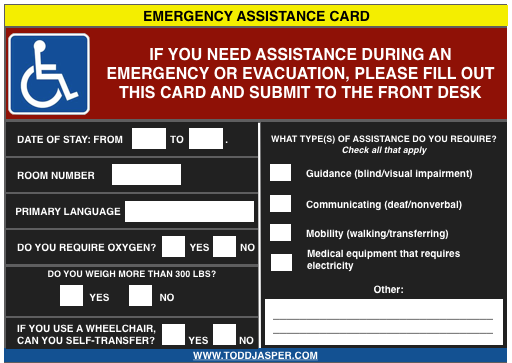
My policy recommendation is that every state, county, city, and community pass a law requiring all hotels/motels, residence halls, high-rise buildings, and other high-occupancy buildings/structures/campuses to distribute a single, double-sided 5×7 inch paper card to all visitors that includes emergency response information as well as a form for visitors to self-identify as needing assistance during emergencies and evacuations.

The front would provide information about emergency evacuation, shelter-in-place, and lockdown procedures (similar to the information required by OSHA in 29 CFR 1910.38). See my example below:

The back of the index card would be a form for individuals requesting special assistance during an emergency or evacuation to fill out and submit to the establishment. See example below:

These are ONLY EXAMPLES for demonstrative purposes, please do not use them. Each facility should consult with trained professionals to determine what information they require and determine processes, policies, procedures, and protocols for providing assistance or communicating the need to provide assistance to first responders for individuals who self-identify. Without a doubt, there ought to be many changes to the cards I developed above. There may be additional information that should be collected, different wording (I created these in about 10 minutes and am making no guarantees about the best way to ask for this sensitive info), a disclaimer regarding privacy policy, and better presentation (I’m no graphics designer).

The benefits of implementing this regulation wouldn’t just be helpful for technological or natural hazards, but manmade incidents as well (such as the 2008 Mumbai terror attacks–including attacks on the Taj Mahal Palace Hotel). During the terror attacks, those with mobility limitations would have been unknown to the hotel staff and there might not have been a process to communicate with first responders the locations and assistance needed by those within the crime scene.

As a society, we shouldn’t wait for tragedy to strike before we decide to improve our preparedness/readiness. While the MGM Grand fire led to extreme changes in fire protection, if we can proactively use regulations and laws to prevent future deaths/injuries (especially for those who can’t help themselves in an emergency), we have an obligation to do so.

In 1992, twelve years after the MGM Grand fire, a small fire broke out at the Riviera Hotel during a national conference for those with spina bifida–a mobility limiting birth defect. The hundreds of individuals in wheelchairs in the convention center were safe–the sprinklers put the fire out in less than a single minute.

_____________________________________________________________
Additional resources for emergency preparedness for individuals with functional and access needs:
  • NFPA: Personal Emergency Evacuation Planning Tool for School Students with Disabilities
  • FEMA: Guidance on Planning for Integration of Functional Needs Support Services in General Population Shelters
  • FEMA Office of Disability Integration and Coordination
  • Ready.gov site for special needs

Share this:

  • Email a link to a friend (Opens in new window) Email
  • Share on X (Opens in new window) X
  • Share on Facebook (Opens in new window) Facebook
  • Share on Pinterest (Opens in new window) Pinterest
  • Share on Reddit (Opens in new window) Reddit
Like Loading...

Disaster Relief: Moral Hazard or Moral Imperative?

06 Tuesday Mar 2012

Posted by toddjasper in EMERGENCY MANAGEMENT

≈ 1 Comment

It seems almost every time I attend an emergency management meeting that is open to the public, someone uses the event as an opportunity to provide political commentary about whether the federal government ought to continue to provide assistance to citizens at all.

At a meeting I attended yesterday, a gentleman raised his voice and interrupted the speaker by yelling about the moral hazard of providing disaster relief rather than forcing citizens to carry insurance for their disaster-related damages. The moral hazard argument is becoming a common criticism of disaster relief by some.

A recent New York Times piece (titled “Moral Hazard: A Tempest-Tossed Idea”) explains that moral hazard is “the undue risks that people are apt to take if they don’t have to bear the consequences.” When applied to disaster relief, the argument is that citizens who are provided with assistance are lulled into complacency and will return to the same lifestyle they enjoyed prior to calamity–thus continuing the cycle of victimization followed by disaster relief. Some conservatives even go so far as to harshly criticize rebuilding campaigns in New Orleans with statements like “they haven’t learned their lesson” and labeling the expenditure of resources in New Orleans as “stubbornness“.

As the NY Times article points out, even the term “moral hazard” is somewhat of a political construct, since “Economists have long complained that moral hazard could easily be described in more neutral language, like “misaligned incentives.” But the term, with its implied judgment, has stuck.” In fact, the term was used to describe reports of misuse of FEMA funds for things like “$438 rooms in New York City and beachfront condominiums in Panama City, Florida, at $375 a night.”

Misuse of FEMA funds is clearly abhorrent but the numbers speak for themselves, and the majority of survivors used their FEMA debit cards for appropriate expenditures. As the GAO reported “debit cards were used predominantly to obtain cash, food, clothing, and personal necessities”.

While some amount of fraud is sadly inevitable, I strongly believe that there is a moral imperative to provide robust disaster relief. As Benjamin Franklin wrote in 1875, “it is better [one hundred] guilty Persons should escape than that one innocent Person should suffer”. Also known as Blackstone’s ratio, justice in the United States is built upon the philosophy that it’s better for a guilty person to go free rather than an innocent person be falsely imprisoned. Applied to disaster relief, it is better for a few impostors to receive disaster assistance fraudulently than for one survivor to go without.

In my opinion, the moral responsibility to our fellow citizens doesn’t end there. I think we are our brother’s keeper.  A recent speech by President Obama after Hurricane Irene demonstrates the good that comes out of disaster. The President explained, “the past few days have been a shining example of how Americans open our homes and our hearts to those in need and pull together in tough times to help our fellow citizens prepare for and respond to, as well as recover from, extraordinary challenges, whether natural disasters or economic difficulties. That’s what makes the United States of America a strong and resilient nation, a strong and resilient people.”

As Kant explains in his writings about the categorical imperative: “Each of us has a moral duty to act not simply ‘in accordance’ with what is right but ‘according to’ it. That is, we should act morally for the sake of acting morally, not, for example, because it will make people like us or get us to heaven.” Applied to disaster relief, as a country, we shouldn’t only provide forms of disaster relief because it generates good publicity or has positive political repercussions. There’s a moral duty to act that supersedes fear of misaligned incentive.

When faced with the chance of inertia due to concerns about moral hazard, the moral imperative to support our citizens in a moment of need ought to prevail every time.

Share this:

  • Email a link to a friend (Opens in new window) Email
  • Share on X (Opens in new window) X
  • Share on Facebook (Opens in new window) Facebook
  • Share on Pinterest (Opens in new window) Pinterest
  • Share on Reddit (Opens in new window) Reddit
Like Loading...

EM Defined: Incident vs Event

25 Saturday Feb 2012

Posted by toddjasper in EMERGENCY MANAGEMENT

≈ 1 Comment

In emergency management, we frequently use the word “event”–and we’re almost always wrong.

It might seem silly, but there is a difference between incidents and events…and it’s often misunderstood or ignored. Below are three examples of the use of the word “event”:

  • “The lessons we have learned from such catastrophic events as the attacks of September 11, 2001, and Hurricane Katrina in 2005 demonstrate…”
  • “These assessments are conducted in counties affected by the disaster event [which was an earthquake]”
  • “The mission of the Federal Emergency Management Agency’s (FEMA) National Special Security Event (NSSE)…”

Can you guess which sentence correctly uses the word “event”?

Hint: it has NOTHING to do with a disaster…

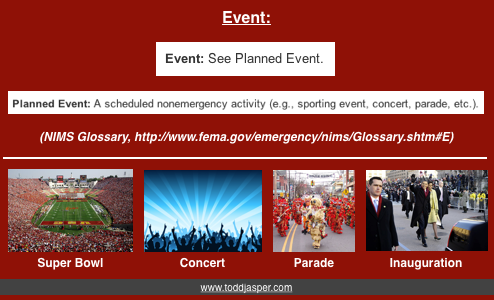
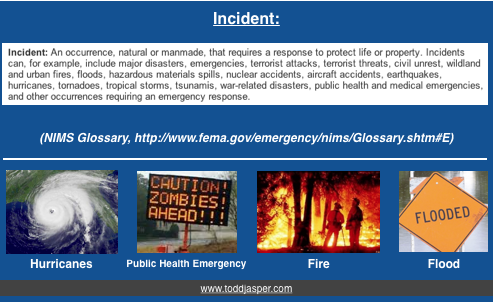
To improve understanding, I’ve created the simple graphic below with the NIMS definition and examples of an event:

The DHS Lexicon also defines event as: “a planned, non-emergency activity occurring in a particular place during a particular interval of time.” (DHS, Lexicon: Terms and Definitions, October 23, 2007, p. 10).

It turns out that events are scheduled and they are NOT EMERGENCIES. The confusion might stem from emergency managers with military experience since the Department of Defense Dictionary of Military and Related Terms, 2007 defines “catastrophic event” as: “Any natural or man-made incident, including terrorism, which results in extraordinary levels of mass casualties, damage, or disruption severely affecting the population, infrastructure, environment, economy, national morale, and/or government functions.”

While the military definition of a “catastrophic event” quickly defers to the definition of an incident, it still harms our collective competency as emergency managers. As emergency managers, a major part of our job is to improve preparedness/readiness through training and consistent application of best practices. Therefore, if we aren’t using jargon or industry terms properly, we’re doing a disservice to ourselves and our field.

While “event” has nothing to do with emergencies, incidents have everything to do with emergencies:

Now, just because an event is planned doesn’t mean it doesn’t require some of the very same resources as an incident. For example, few wildfires receive as many resources as the inauguration of the President of the United States of America. As emergency managers, we spend a lot of time preventing events from turning into incidents (like planning and positioning of resources so that fans from a sports game [event] do not start a riot [an incident]). While events can turn into incidents, incidents really can’t become events.

Hope this was helpful! In a future post, I’ll address what “verbiage” really means…

Share this:

  • Email a link to a friend (Opens in new window) Email
  • Share on X (Opens in new window) X
  • Share on Facebook (Opens in new window) Facebook
  • Share on Pinterest (Opens in new window) Pinterest
  • Share on Reddit (Opens in new window) Reddit
Like Loading...

EM Defined: Preparedness vs. Readiness

19 Sunday Feb 2012

Posted by toddjasper in EMERGENCY MANAGEMENT, HOMELAND SECURITY, PREPAREDNESS

≈ Leave a comment

Trying to define preparedness or readiness can be a frustrating task. It turns out that while there are many definitions, most skirt the task of actually providing a useful definition. For example, Webster’s dictionary defines preparedness as “the quality or state of being prepared” (prepared is defined as “subjected to a special process or treatment”). Poor definition leads to poor comprehension, which impedes our collective ability to improve preparedness.

In fact, when PricewaterhouseCoopers’ Health Research Institute (HRI) polled industry leaders in 2007 to define preparedness, “they agreed on only two things: (1) there is currently no universally accepted definition of preparedness; and (2) we must continue getting ‘better prepared.’” 

The DHS Lexicon (2007) defined preparedness as “activities necessary to build, sustain, and improve readiness capabilities to prevent, protect against, respond to, and recover from natural or man-made incidents.” Note that this definition mentions readiness. There’s a lot of confusion regarding preparedness and readiness. In fact, the now defunct Homeland Security Presidential Directive (HSPD)-8, explains that “The term ‘preparedness’ refers to the existence of plans, procedures, policies, training, and equipment necessary at the Federal, State, and local level to maximize the ability to prevent, respond to, and recover from major events. The term ‘readiness’ is used interchangeably with preparedness.”

While the DHS Lexicon equates readiness with preparedness, I have a different perspective. In my opinion, preparedness is the sum of plans, policy, procedures, protocols, risk/hazard/threat/vulnerability identification/analysis, and development of training curriculum for incident response/recovery. In my opinion, readiness is somewhat different. Readiness is the capability of successfully responding or conducting recovery operations (in other words, the ability to implement processes, procedures, etc included in preparedness).

For example, police officers don’t have much preparedness on a normal patrol (a police car equipped with a shotgun and some flares) but police officers maintain a high degree of readiness (in the sense that they are able to respond quickly, understand how to order additional resources, and are generally well-trained). Developing the training is preparedness but ensuring that everyone is trained and able to execute their function is readiness.

While the differences between the two concepts might seem slight, both concepts are crucially important to ensuring a proper balance between theory and practice in maintaining successful and progressive emergency management programs.


Share this:

  • Email a link to a friend (Opens in new window) Email
  • Share on X (Opens in new window) X
  • Share on Facebook (Opens in new window) Facebook
  • Share on Pinterest (Opens in new window) Pinterest
  • Share on Reddit (Opens in new window) Reddit
Like Loading...

Link

My Interview on Mitigation Journal

18 Saturday Feb 2012

Posted by toddjasper in EMERGENCY MANAGEMENT

≈ Leave a comment

Recently I had the pleasure of being interviewed by Mr. Rick Russotti–famous for his Mitigation Journal Blog. The interview is about 30 minutes and is available here. We covered a lot of great topics, it might be worth a listen!

Share this:

  • Email a link to a friend (Opens in new window) Email
  • Share on X (Opens in new window) X
  • Share on Facebook (Opens in new window) Facebook
  • Share on Pinterest (Opens in new window) Pinterest
  • Share on Reddit (Opens in new window) Reddit
Like Loading...

Emergency Manager: “What People Think I Do / What I Really Do” Meme

15 Wednesday Feb 2012

Posted by toddjasper in EMERGENCY MANAGEMENT

≈ 3 Comments


Emergency manager memeI’ve seen this meme a lot recently and thought it might be fun to make one for emergency managers!

For clarity, the “what my family thinks I do” is a guy on a segway handing out water bottles… and the “what I actually do” pic is from the famous cowboys herding cats video.

Share this:

  • Email a link to a friend (Opens in new window) Email
  • Share on X (Opens in new window) X
  • Share on Facebook (Opens in new window) Facebook
  • Share on Pinterest (Opens in new window) Pinterest
  • Share on Reddit (Opens in new window) Reddit
Like Loading...

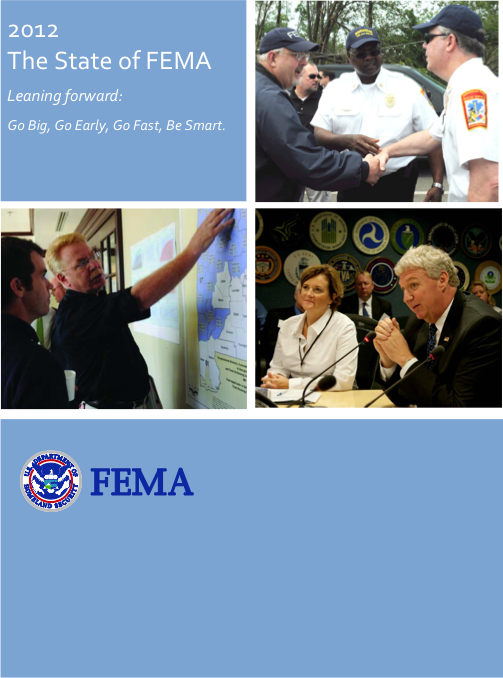
The State of FEMA: Leaning Forward: Go Big, Go Early, Go Fast, Be Smart

14 Tuesday Feb 2012

Posted by toddjasper in EMERGENCY MANAGEMENT

≈ Leave a comment

Today FEMA released “The State of FEMA” as an overview of FEMA’s vision and strategy (with a lot of Whole Community approach). It’s a smart idea, especially since (as the report quickly mentions) FEMA responded to more disasters in 2011 than ever before (98 major disaster declarations, 26 emergency declarations, and 112 fire management assistance grant (FMAG) declarations). There’s no doubt FEMA has been undergoing a profound transformation under Mr. Fugate and it’s pretty impressive. Among all else, Mr. Fugate has transitioned FEMA from a federal response to a NATIONAL response (with national planning/preparedness and prevention/protection efforts now in full swing).

Highlights include

  • National Disaster Recovery Framework (NDFR) released
  • National Mass Care Strategy developed
  • FEMA Qualification System implementation
  • Establishment of Presidential Policy Directive (PPD)-8 Program Executive Office (PEO)
  • FEMA helped train more than 428,000 individuals as part of the Community Emergency Response Teams (CERT) program. Overall, more than 1.3 million CERT volunteer hours were recorded in 2011
  • Emergency Alert System was tested nationally for the first time

The document even provides explanation of FEMA’s guiding principles, the FEMA culture, and strategic priorities (particularly impressive when the document routinely makes statements like “In 2012, FEMA will…”). It’s rare in government to see such assertive (or as FEMA and MSNBC puts it “forward leaning”) statements.

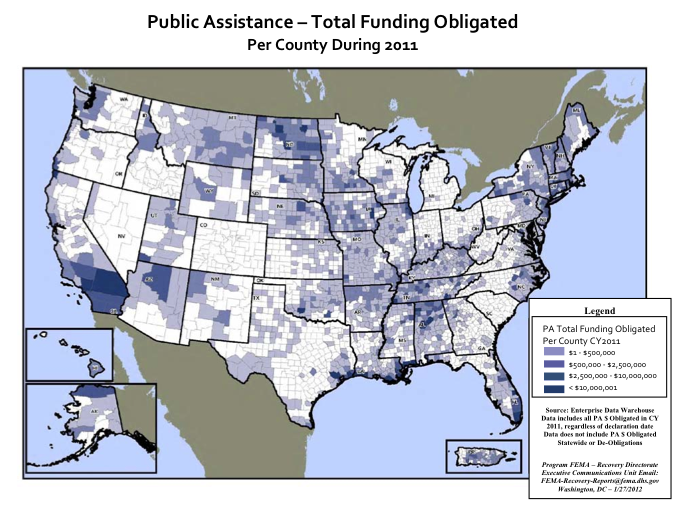
More than ever before, FEMA is emphasizing comprehensive emergency management that includes community members. The document pretty much mentions community engagement efforts on every page. But it’s not just anecdotes, FEMA uses hard data to explain the amount of funding and response efforts across the nation (see map below). The document provides data about training, program implementation, and even mitigation and IPAWS.

This document does an excellent job of explaining what FEMA is doing, how it is doing it, what the results have been, and exactly what FEMA plans to do in 2012. The military talks about transformation quite a bit, but I couldn’t be more impressed by the transformation occurring at FEMA–especially during a year with the most disasters on record. It’s an extraordinary time at FEMA now and I have no doubt it’s to the benefit of Americans now, but also for future generations.

Share this:

  • Email a link to a friend (Opens in new window) Email
  • Share on X (Opens in new window) X
  • Share on Facebook (Opens in new window) Facebook
  • Share on Pinterest (Opens in new window) Pinterest
  • Share on Reddit (Opens in new window) Reddit
Like Loading...

Relocation After Evacuation: The Danger of Outdoor Evacuation

11 Saturday Feb 2012

Posted by toddjasper in CAMPUS SAFETY, SECURITY, & PREPAREDNESS, EMERGENCY MANAGEMENT, PREPAREDNESS, RESPONSE

≈ Leave a comment


I frequently teach emergency management classes/trainings and the topic of evacuations comes up a lot. Even when I teach emergency managers, I’m often surprised by how few understand the concept. The objective of evacuation is to relocate to a place of greater-known safety (ideally to a location that permits continued sheltering-in-place).

Most folks think of evacuation as just getting out of dodge. Essentially, we have quite an elementary mindset of evacuation. Literally elementary. The standard we seem to have adopted is that we all simply file through the exits and make our way outside. Seemingly, that’s when most emergency management plans end. Fortunately, that is not when our duty as emergency managers ends.

Just like the captain of a ship, the duties of an emergency manager don’t end once we leave the building. Our duty extends until the folks we serve are safe (and that is not synonymous with outdoors!)

Of course, we recognize that sending folks outside isn’t always the safest course of action (if that were the case, we would just always evacuate). For instance, if we suspected that there were anthrax in the air outside, we wouldn’t evacuate outdoors. Similarly, if there were evidence of HAZMAT outdoors, we would shelter-in-place rather than evacuate.


Too frequently we neglect to consider the effects of outdoor evacuation posed by inclement weather, potential for secondary attack/sniper, damages/injuries caused by secondary improvised explosive devices (IED) intended for responders/evacuees, and lack of accommodations for those with functional/access needs as well as those with medical issues.

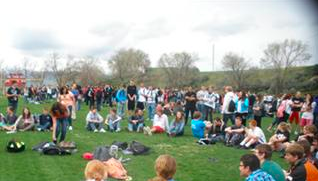
For example, in 1998, two students activated the fire alarm at a middle school and took up shooting positions around the outdoor field. The result was the Westside Middle School massacre with five people killed. In 1974, five people were killed and 11 injured when a student in New York fired on his classmates as they evacuated Olean High School.

I propose an evacuation decision-making process that begins with notification of a hazard and concludes with a rapid assessment to relocate to an alternative indoor location or return quickly indoors to the primary location. You’ll notice that evacuation is the HALFWAY point of the process, not the terminal activity. It is vitally important for emergency managers to understand that safety is not intrinsically linked with the outdoors.

Indeed, when folks have evacuated outdoors, there are many safety and security concerns present. For individuals with medical conditions, will they be able to take medication outdoors? What if they require privacy, drinking water, or a sharps container? Is there perimeter security for an outdoor evacuations (also known as “force protection”)? If the weather is severely cold, is ice accumulation a hazard? Is there the threat of frostbite? During severely hot weather, individuals outside for extended periods of time may become victims of heatstroke, dehydration, and other medical problems associated with exposure. When individuals are forced to evacuate and stand outdoors for extended periods of time, the potential for secondary medical emergencies and abandonment (the act of one or more individuals abandoning the evacuation effort) increases.

During an evacuation, discipline and accountability are crucial. Poor communication, inconsiderate attitudes towards those with special needs, and discomfort due to environmental conditions are all issues that plague evacuations and can lead to discord among the evacuated masses. As emergency managers, we must recognize that an outdoor evacuation should be planned to be as rapid as possible. If immediate return to the affected building is impossible, emergency managers must have a plan to immediately relocate personnel to an indoor evacuation rendezvous point. 

Hopefully, if we rebel against an “elementary” mindset of evacuation and plan for immediate relocation after evacuation, we’ll reduce the collective risk of injury or death due to outdoor safety/security concerns.

Share this:

  • Email a link to a friend (Opens in new window) Email
  • Share on X (Opens in new window) X
  • Share on Facebook (Opens in new window) Facebook
  • Share on Pinterest (Opens in new window) Pinterest
  • Share on Reddit (Opens in new window) Reddit
Like Loading...

My ICS Wedding Plan

04 Saturday Feb 2012

Posted by toddjasper in EMERGENCY MANAGEMENT

≈ 4 Comments

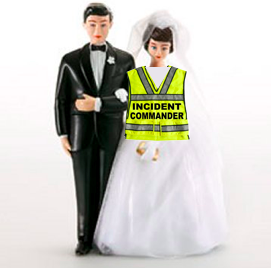
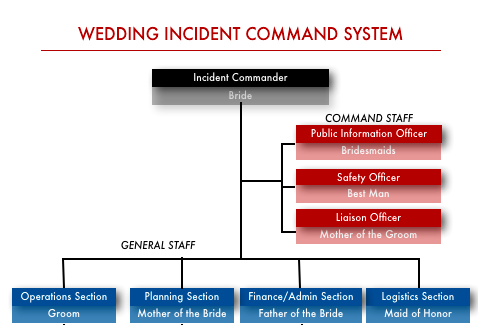
I’ve been a professional planner since 2005 for emergencies, continuity of operations, and strategic recovery plans. When I got engaged last December, I knew wedding planning would be a new frontier. As I’m starting the wedding planning process, I can’t help but notice how ICS is applicable to many of the roles and responsibilities. Just for kicks, I developed the ICS chart below…

I’m sure there are many other slots that could be activated (lodging, food unit, etc). Just goes to show how ICS is truly scalable and flexible.

Share this:

  • Email a link to a friend (Opens in new window) Email
  • Share on X (Opens in new window) X
  • Share on Facebook (Opens in new window) Facebook
  • Share on Pinterest (Opens in new window) Pinterest
  • Share on Reddit (Opens in new window) Reddit
Like Loading...
← Older posts
Newer posts →

Enter your email address to follow this blog and receive notifications of new posts by email.

Join 49 other subscribers

Recent Posts

  • Todd’s Interview: “Questions Raised about Police Response in Capitol Shooting”
  • Todd’s NPR Interview on Tragic Navy Yard Mass Shooting
  • 5 Reasons Your Agency Should Have a Smartphone App
  • FEMA Releases Revised Federal Continuity Directive 2 (FCD-2)
  • Intro to IAEM Emerging Technologies Caucus (ETC)

Todd’s Tweets

Tweets by toddjasper

Categories

  • #SMEM
  • ABOUT TODD
  • CAMPUS SAFETY, SECURITY, & PREPAREDNESS
  • CONTINUITY OF OPERATIONS
  • EMERGENCY MANAGEMENT
  • EMERGENCY NOTIFICATION
  • HOMELAND SECURITY
  • PREPAREDNESS
  • PUBLIC HEALTH
  • RECOVERY
  • RESPONSE

Blog at WordPress.com.

  • Subscribe Subscribed
    • toddjasper
    • Join 49 other subscribers
    • Already have a WordPress.com account? Log in now.
    • toddjasper
    • Subscribe Subscribed
    • Sign up
    • Log in
    • Report this content
    • View site in Reader
    • Manage subscriptions
    • Collapse this bar
 

Loading Comments...
 

    %d