• About Todd
  • Best of the Blog
  • Memes
  • Reading List
  • Todd’s Publications

toddjasper

~ Amat victoria curam

toddjasper

Author Archives: toddjasper

Chevy Chase Patch Article: When to Call 911

03 Friday Feb 2012

Posted by toddjasper in EMERGENCY MANAGEMENT

≈ Leave a comment

Tags

bystander effect, diffusion of responsibility, emergency preparedness, kitty genovese

Every month I have an emergency preparedness article in the local newspaper (ChevyChase.Patch.com). Here’s the link to February’s article. I’ve also copied it below:

On March 11, 2011, employees at the Apple store in Bethesda heard screams for help and sounds of a fight but did nothing.

The next day, Apple employees were shocked to discover police officers investigating a murder that occurred next-door at the Lululemon store. At sentencing for the murderer last month, Montgomery County Judge Robert A. Greenberg delivered an impassioned speech that included mention of the Apple store employees: “the callous indifference of those Apple store employees,” Greenberg said.“They did not do a blessed thing.” The best and easiest thing would have been for witnesses to call 911.

Unfortunately, societal indifference is more common than we would hope. In October 2011, a toddler in China was repeatedly hit by traffic on a busy street. More than 18 people witnessed the accident without rendering aid or calling for help. This calloused behavior is referred to by psychologists as “bystander effect.”

The most famous example of “bystander effect” in the United States was the stabbing murder of Kitty Genovese in March 1964 in Queens, NY. More than a dozen people heard Genovese’s screams, yet there were not a dozen calls for help. Psychologists have noticed a trend of “diffusion of responsibility” in crowds or groups when an emergency occurs, yet no one acts. Inaction in a crowd is contagious and provides justification to others in the crowd that action is not needed. The U.S. military noticed this unfortunate trend as well; the military even developed “bystander training” to fight against witness inaction.

To insulate ourselves from diffusion of responsibility or bystander effect/indifference, each of us needs to be cognizant of when it is appropriate to call for help. We may not be required to involve ourselves in dangerous situations, but with the constant police presence in Chevy Chase, help is always a call away.

Montgomery County Police Sgt. Jennifer McNeal explains that the public should not feel they are inconveniencing law enforcement by calling 911 for suspicious circumstances.

“It’s our job,” said McNeal, “to make sure people are safe.” McNeal recommends that citizens call 911 immediately if they see a crime being committed or “if you see someone needs help or hear anything that requires police investigation, such as a gunshot, screams, sounds of a struggle or if something catches your eye as out of ordinary, please call 911 so that we can investigate,” McNeal explains.

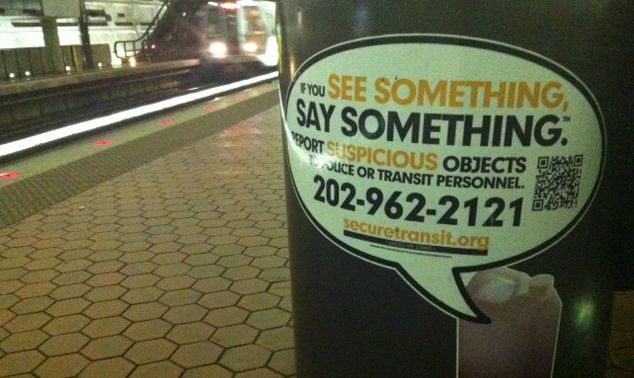
In fact, police departments in the area have taken part in the “If You See Something, Say Something!” campaign to encourage citizens to report emergencies, suspicious behavior, unattended bags or other events/activities that authorities should investigate.

Below are the phone numbers and other methods for contacting local police departments in the Chevy Chase area. (You may wish to store them in your phone’s memory.)

Chevy Chase Police Department
EMERGENCY: 911
Non-emergency: 301-654-7300

Montgomery County Police, District 2 (Bethesda/Chevy Chase)
EMERGENCY: 911
Non-emergency:

  • 301-652-9200
  • Text “MCPD” to 274637
  • Submit a web tip

Maryland-National Capital Region Park Police
EMERGENCY: 301-949-3010
Non-emergency: 301-949-8010

Metro-Transit Police
EMERGENCY: 202-962-2121

Remember, if you encounter anything suspicious, call 911. As a community, we all have a moral imperative to help one another in a time of need, even if it just means dialing 911.

Share this:

  • Email a link to a friend (Opens in new window) Email
  • Share on X (Opens in new window) X
  • Share on Facebook (Opens in new window) Facebook
  • Share on Pinterest (Opens in new window) Pinterest
  • Share on Reddit (Opens in new window) Reddit
Like Loading...

Avoiding the Fate of Napoleon (Arkansas): Designing Successful Recovery Efforts

01 Wednesday Feb 2012

Posted by toddjasper in PREPAREDNESS, RECOVERY

≈ Leave a comment

Tags

Arkansas, ESF-14, FEMA, long-term community recovery, LTCR, Napoleon, national disaster recovery framework, NDRF, recovery, whole community

I spent yesterday in Harrisburg, PA at the Region III National Disaster Recovery Framework (NDRF) Stakeholder Engagement Workshop. While it was great to see so many emergency management professionals dedicated to recovery, it was also quite clear that these types of discussions about recovery are just the beginning of crucial recovery planning at every level. Collectively, we’ve spent enormous resources on response and now, with the NDRF, our focus is being re-adjusted to better understanding–and planning–recovery.

In 1884, a flood inundated the town of Napoleon, Arkansas. The flood occurred before the Stafford Act, no significant recovery operations were implemented, and the town never recovered. In fact, they say during low tide you can still see remnants of Napoleon in the sandbars of the Mississippi River near where the town originally stood. The fate of Napoleon, Arkansas is a symbol of failed recovery.

As our capabilities, technology, and institutions of government have matured, the processes for federal assistance for disaster relief and recovery were codified and they seemed to work well. Hurricane Camille, the 1993 “Storm of the Century”, the 1972 Rapid City Flood (which claimed 238 lives), and the Northridge Earthquake all received disaster declarations and required major disaster relief by the United States Federal government.

The prolonged suffering after Hurricane Katrina re-enforced the moral imperative of well-designed recovery–at every level. Katrina was the catalyst for the entire emergency management industry to re-examine and redefine recovery. It’s taken years but we are now advancing new concepts and completely new schools of thought regarding recovery. ESF-14 Long-Term Community Recovery (LTCR) was the first formal promulgation of strategy for implementing untraditional methods of recovery.

LTCR is a community-driven post-disaster planning process that articulates ideas and priorities expressed by the community for recovery. The LTCR process relies on community consensus as a feedback loop to innovative community development and strategic application of grants and governmental programs. The following plans are examples of the LTCR planning process:

  • Chambers County, Texas (2009)
  • Gays Mills, Wisconsin (2008)
  • Charlotte County, Florida (2004)

While LTCR is emblematic of the Whole Community approach, is still a very reactive process. NDRF takes most of the principles of LTCR and shapes the implementation of those principles into a recovery continuum. The NDRF encourages proactive, pre-disaster planning at all levels of government.

By proffering recovery support functions, the NDRF formalizes recovery lines of operation, such as:

  • Community Planning and Capacity Building
  • Economic
  • Health and Social Services
  • Housing
  • Infrastructure Systems
  • Natural and Cultural Resources

While the annexes for each of the RSFs are in the works, there is still an enormous amount of effort needed to develop pre-disaster recovery plans at all levels of government and community development. In order to avoid future Napoleons, we must prepare for a meticulously well-designed recovery.

Share this:

  • Email a link to a friend (Opens in new window) Email
  • Share on X (Opens in new window) X
  • Share on Facebook (Opens in new window) Facebook
  • Share on Pinterest (Opens in new window) Pinterest
  • Share on Reddit (Opens in new window) Reddit
Like Loading...

10 Awesome Life-Saving Products

26 Thursday Jan 2012

Posted by toddjasper in EMERGENCY MANAGEMENT

≈ Leave a comment

The last top-ten list I made was about cool disaster gadgets and it was a big hit. Below I’ve compiled ten awesome life-saving products. I’m not vouching for them, but they appear to be pretty neat…

BULLETPROOF BACKPACK
Although it’s expensive ($399), this normal-looking backpack will stop most handgun bullets. The website even has instructions for use: Hold pack between yourself and the shooter using the shoulder straps as handles. Use as a shield to provide cover for upper torso and head whenever possible. While taking shelter, use pack to protect yourself in the direction of the threat.

CHEMICAL SPILL ESCAPE MASK
You never know when you’re going to be a little too close to a chemical spill. Just in case, this escape mask can help! This mask is a personal emergency device for short-term respiratory protection during escape from an area of a chemical spill. Offers protection against organic gases and vapors with a boiling point higher than 65°C, certain inorganic gases and vapors, sulfur dioxide and other acidic gases and vapors, ammonia and ammonia derivatives. Large visor, made of flame-retardant transparent film, allows a wide field of view. One size fits all and it folds up to fit in your pocket!

ESCAPE LADDER
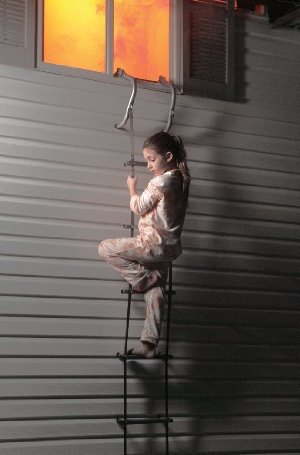
Sometimes the only way to get out of dodge is to go out the window. This escape ladder is pretty nifty. Not only does the ladder collapse into a small little kit, but it has a sturdy clamp for windowsills. A really nice feature of this ladder are the external pegs that brace the ladder against the exterior of the wall. As your foot moves to the next rung, the pegs provide a counter-balance against the wall (so that you can get a strong foothold on each rung instead of having the ladder slack against the wall). Also, it’s important to note that this ladder is metal rather than nylon (which will melt in a fire).

ESCAPE CHUTE
In case your window is higher than the escape ladder will reach, you can install the escape chute (can’t miss this video, yikes!). There are several models, but they all involve you bailing out into a really, really long tube (you may or may not be able to see the bottom from the top of this thrill ride). Some of the tubes require anchors while others allow you to extrude out the bottom of the chute unassisted. While it might save your life, there doesn’t appear to be a graceful or non-terrifying way to drop ten stories from the outside of a building.

FIREFIGHTING BOMB
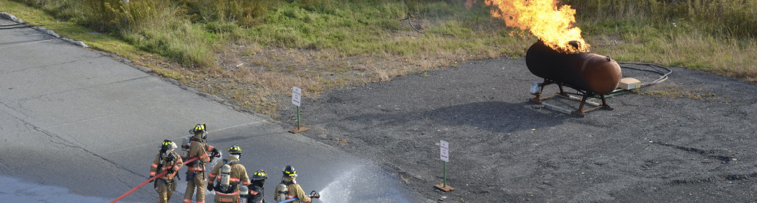
The Russian company Bazalt might be on to something. This bomb-looking device is meant to be dropped by an airplane and is marketed to put out up to 1,000 square yards of flame. They call it an “aerial firefighting explosive device”. If you click on the title of this paragraph, you’ll see a pretty incredible video of this bomb at work.


INFLATABLE PERSONAL FLOTATION DEVICE
This PFD is pretty neat. When it’s worn but not inflated, the vest is pretty small and doesn’t get in the way. When submersed in water, a cartridge of CO2 is used to inflate the vest. The vest can also be deployed manually by pulling on the yellow tab (let’s say you anticipate landing in the drink and want the comfort of activating your vest before you’re chin-deep).

AVALANCHE AIRBAGS
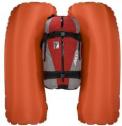
It works like this: if a skier finds herself trapped under heavy snow, the system will inflate to give pinned athletes 150 liters more body volume, equalizing some of the extreme density and helping to bring the body towards the surface as the snow gains speed. Compared to airbags in your car, this body-worn variety utilizes nitrogen canisters rather than CO2, a gas that’s safe to travel with as long as TSA gives you the go-ahead.

AVALUNG REBREATHER
Another lifesaving device for use during avalanches is the Avalung. This device works by taking the air you exhale and as your carbon dioxide-saturated breath exits through the bottom end of the rig,  your body acts as a barrier separating the “good” unused air from the “bad” exhalation. Otherwise, CO2 would build up in front of your face, causing snow to refreeze around your face and lead to suffocation.
BOTTLE SCREENER
Afraid that your water bottle or 20 ounce soda might contain a liquid explosive? This tabletop beverage inspection system is designed to quickly screen liquids in bottles where the threat may be present. The MS100P is for use at checkpoints, prisons, events and wherever liquids in bottles are security concern.

Bottles are automatically evaluated in less than 3 seconds. A green light indicates that the bottled beverages are safe, a red light signals an operator to take action (which I assume is a fancy way of saying: “RUN!”)

PERSONAL LIFE RAFT
Sometimes you just need the added peace of mind knowing you have your own life raft at your disposal.  For people like you, the Offshore Commander comes with the following items: inflatable floor, canopy light & reflective tape, rugged, oversized double tubes, automatic inflatable canopy, boarding ladder, righting strap and safety lifelines. The raft comes vacuum-packed for easy storage.

Share this:

  • Email a link to a friend (Opens in new window) Email
  • Share on X (Opens in new window) X
  • Share on Facebook (Opens in new window) Facebook
  • Share on Pinterest (Opens in new window) Pinterest
  • Share on Reddit (Opens in new window) Reddit
Like Loading...

Active Shooter Training Isn’t Just for Cops and Teachers…

21 Saturday Jan 2012

Posted by toddjasper in CAMPUS SAFETY, SECURITY, & PREPAREDNESS, HOMELAND SECURITY, PREPAREDNESS, PUBLIC HEALTH, RESPONSE

≈ 1 Comment

Tags

arlington county virginia, first aid kit, journal of emergency medical services, swat medic, swat team

The first active shooter exercise I witnessed (in 2002) ended with the shooter starting to open fire on his victims, the SWAT team appearing from nowhere then throwing a flash-bang device, and taking the suspect into custody. Before the controller yelled “ENDEX”, the last thing I heard was one of the police officers calling on his radio to send in the medics.

In Tucson, Arizona last year, deputies arriving to the scene of the Rep. Giffords shooting gained notoriety for using special medic kits to provide first aid to the injured. In Tucson, a SWAT medic had assembled $99 kits for police officers based on the military’s Improved First Aid Kit (I-FAK).

Many law enforcement agencies see their job as done once the scene is rendered safe. The Giffords shooting directed national attention to the valiant medical aid the deputies provided after handcuffing the shooter. More agencies are realizing the need for advanced medical training, equipment, and preparedness for all first responders. A recent article in Rialto, CA profiles a emergency room physician who joined Rialto’s SWAT team (they call him the “SWAT Doc”). In the article, Dr. Neeki is quoted saying “it is important for SWAT team paramedics to have advanced training in wound care, airway management techniques, and procedures for spinal injuries.” The doctor is right.

From my personal experience, few fire departments and emergency medical services folks are trained in active shooter response alongside law enforcement. Thus, in my opinion, the response is often disjointed (such as the scene I described where the police capture the bad guy and fail to assist in triage/first aid).

Arlington County, Virginia realized its fire fighters and EMS were not able to be as proactive in response to active shooter scenarios as they desired to be. An excellent, must-read article in the December 2009 issue of the Journal of Emergency Medical Services (JEMS), describes what Arlington County found to be the problem. The article explains: “The current standard fire/EMS response to the active shooter is to stage in a secure location until police mitigate the threat and secure the area to create a scene safe for fire/EMS operations. But there’s a basic problem with this response: While waiting for a secure scene, those injured inside the building aren’t receiving care and are dying from their injuries.” To address this issue, Arlington assembled task forces of medics and police officers to improve safety for their responders while also improving the quality and speed of care for survivors of active shooter incidents. The task force developed protocols for responding to active shooters based on the Tactical Combat Casualty Care (TCCC) school of thought. The TCCC concept was developed in 1996 and was first released in Military Medicine by CAPT Frank K Butler, Jr., MC USN, LTC John Hagmann, MC US, ENS E. George Butler, MC USN.

The major differences between traditional care and TCCC care during mass casualty incidents (with combat-like mechanisms of injury) cited in the JEMS article are the following:

  • Airway control is not the first priority. Not only are exsanguinating extremity wounds far more common than airway injury, but a person can bleed to death from a large arterial wound in two to three minutes, while it may take four to five minutes to die from a compromised airway.
  • Because supplies and resources are limited in combat and austere environments, medical treatment and stabilization must be done expediently with minimal supplies. Tourniquets are emphasized and prioritized as a quick and effective method to control extremity hemorrhage.
  • For non-exsanguinating hemorrhage, mechanical pressure dressings with wound packing are used. Some wounds, including those in the femoral triangle or in the neck, are not amenable to tourniquets. These wounds are controlled using hemostatic agents, such as Celox, QuikClot ACS and HemCon, in conjunction with direct pressure.
  • For airway control, nasopharyngeal airways are emphasized over oropharyngeal or endotracheal intubation; nasal airways are fast, stable and effective in all unconscious or altered mental status patients, regardless of the presence of a gag reflex. Intubation is de-emphasized because it requires extra equipment and loss of situational awareness.
In Arlington, the fire department established Rescue Task Forces (RTF) to incorporate TCCC principles into active shooter response. RTFs work in the following ways:
  • The first one or two RTF teams that enter the building move deep inside to stabilize as many victims as possible before any one victim is evacuated. As victims are reached, the RTF police officers provide security in place while the medics treat the victims. Using the concepts of TCCC, they stabilize only the immediately life-threatening wounds on each patient they encounter, but leave these patients where they are found and move on.
  • Medics are outfitted in ballistic vests and helmets to further mitigate the risk of operating in this environment. Based on daily staffing in Arlington County, a total of seven RTFs can be formed at any time, each equipped to carry enough supplies to treat up to 14 victims, depending on their injuries.
  • The number of victims that can be stabilized by these initial RTF teams is limited only by the amount of supplies carried in. Once out of supplies, teams start moving back out of the building, evacuating patients they’ve treated. At the same time, additional RTF teams are formed as personnel become available; these teams are brought in with the primary mission of evacuating the remaining stabilized victims.
  • A supply depot is set up near the entry point to the area of operations to allow for quick re-supply and turnaround for RTF teams. If needed, an internal casualty collection point will be set up near a secure entry point, where casualties can be grouped to allow for faster and more efficient evacuation by non-RTF EMS personnel.
  • All patients are eventually evacuated to an external casualty collection point well outside the building in a secure location where traditional EMS care is initiated.
While definitely sophisticated, I believe the system Arlington County developed is excellent at providing a confident response to an active shooting. Recently, in the District of Columbia, medics near a shooting actually hid rather than respond (DC ambulance hides after mass shooting). A confident and safe response is necessary in all jurisdictions. And please, next time you have an active shooter exercise, don’t stop the exercise when the cops take out the bad guy–real life consequences demand that we train to continue providing care to the injured after the threat has been terminated.

Share this:

  • Email a link to a friend (Opens in new window) Email
  • Share on X (Opens in new window) X
  • Share on Facebook (Opens in new window) Facebook
  • Share on Pinterest (Opens in new window) Pinterest
  • Share on Reddit (Opens in new window) Reddit
Like Loading...

Chevy Chase Patch.com Article

20 Friday Jan 2012

Posted by toddjasper in EMERGENCY MANAGEMENT

≈ Leave a comment

Today marks the debut of my monthly disaster preparedness column for my local online newspaper, the Chevy Chase Patch.

My dramatically titled article is “3 Easy Steps Could Save Your Life”

Enjoy!

Share this:

  • Email a link to a friend (Opens in new window) Email
  • Share on X (Opens in new window) X
  • Share on Facebook (Opens in new window) Facebook
  • Share on Pinterest (Opens in new window) Pinterest
  • Share on Reddit (Opens in new window) Reddit
Like Loading...

What’s a Disaster?

17 Tuesday Jan 2012

Posted by toddjasper in EMERGENCY MANAGEMENT

≈ Leave a comment

For those of us in emergency management, we often talk about disasters, incidents, events, emergencies, catastrophes, and disruptions. When I teach FEMA courses, sometimes the exact definition of disaster comes up–but few people are prepared to answer “What is a disaster?” I often ask “Is a category 5 hurricane a disaster”? A lot of people usually nod in agreement. Then I ask “what if the hurricane stays over the ocean and doesn’t affect any humans?” Not a disaster, right? More heads nod.

I alway like to start by discussing the etymology of “disaster” (mostly because I’m an EM geek). The word “disaster” was formed from “dis” (which means apart/away) and “astro” (which means “star, planet”). In other words: “ill-starred” or against the stars, such as an astrological explanation for “a calamity blamed on an unfavorable position of the planet.” While it’s interesting to understand how “disaster” got its groove in the 1560’s, how we use the term today is important–especially as it pertains to disaster declarations and how we define when a situation transforms from a simple emergency to a disaster.

In fact, FEMA routinely sidesteps defining “disaster”. FEMA’s glossary of terms doesn’t have a definition for disaster, neither does the National Response Framework glossary nor the ICS Resource Center Glossary.

Instead, FEMA relies on the Stafford Act definition of a “major disaster”: which is “any natural catastrophe (including any hurricane, tornado, storm, high water, winddriven water, tidal wave, tsunami, earthquake, volcanic eruption, landslide, mudslide, snowstorm, or drought), or, regardless of cause, any fire, flood, or explosion, in any part of the United States, which in the determination of the President causes damage of sufficient severity and magnitude to warrant major disaster assistance under this Act to supplement the efforts and available resources of States, local governments, and disaster relief organizations in alleviating the damage, loss, hardship, or suffering caused thereby.” In other words, the definition of a major disaster is almost any situation in which the President decides to declare it a disaster.

Dr. Wayne Blanchard authored the Guide to Emergency Management and Related Terms, Definitions, Concepts, Acronyms, Organizations, Programs, Guidance, Executive Orders & Legislation in 2008. It’s an extraordinary resource for definitions and an annotated history of emergency management terms. Dr. Blanchard wasn’t able to narrow down a single definition either. In fact, the definitions for “disaster” start on page 275 and continue to page 285.

Definitions include the typical definition used in emergency management textbooks: “An event that requires resources beyond the capability of a community and requires a multiple agency response.”

The Merriam-Webster definition: “a sudden calamitous event bringing great damage, loss, or destruction; broadly : a sudden or great misfortune or failure”

Then there are several interesting definitions, including:

  • the economic definition: “an incident causing at least USD $5 million in damages”
  • a sociological definition: “a type of collective stress situation in which ‘many members of a social system fail to receive expected conditions of life from the system”
  • the cynical, sociological boomerang definition: “disasters become the basis for rebuilding social inequalities and perhaps deepening them, thus setting the stage for the next disaster”
  • the subjective perspective: “Disasters are subjective phenomena. They arise from the behavior of complex systems, are perceived and take place in a specific socio-economic, historical, cultural and chronological context.”
  • the capacity-based definition: “A disaster is a non-routine event that exceeds the capacity of the affected area to respond to it in such a way as to save lives; to preserve property; and to maintain the social, ecological, economic, and political stability of the affected region.”

I usually prefer the last definition. For my purposes as an emergency manager, that definition successfully balances the impact of the hazard on unassisted response/recovery, includes the life-threatening consequences in response to the hazard, and makes mention of the various lines of operation affected by disaster (sociological, environmental/ecological, economical, and political).

Leave a comment with your preferred definition!

Share this:

  • Email a link to a friend (Opens in new window) Email
  • Share on X (Opens in new window) X
  • Share on Facebook (Opens in new window) Facebook
  • Share on Pinterest (Opens in new window) Pinterest
  • Share on Reddit (Opens in new window) Reddit
Like Loading...

Ten Cool Disaster Preparedness Gadgets

13 Friday Jan 2012

Posted by toddjasper in EMERGENCY MANAGEMENT, PREPAREDNESS

≈ 3 Comments

Being a self-diagnosed Apple addict, a contributing member of the #SMEM community, as well as a member of IAEM’s new Emerging Technology Caucus, I can’t help but love gadgets. I’ve compiled a list of some of the coolest disaster preparedness gadgets, enjoy!

PowerBag ($139)

Sick of dead batteries? This backpack comes with a built-in battery. So when you throw your phone or iPad in there, it charges while you’re on the go! Pretty decent, but a little pricey at $139. Still cool though…


Jumpstart/Air Compressor/Power Outlets ($100)

Ever had your car battery die and then you have to wait either for some kind soul to offer you a jump or wait 3 hours for roadside assistance? You can avoid that entire fiasco and waste of time with the Cobra. It will jumpstart your car, has both D/C and A/C outlets, a USB terminal for charging mobile devices, a super bright LED light, and an air compressor for filling your car’s tires or an air mattress.

Magnesium Fire Starter, Whistle, and Keyring ($9)
A keyring, fire starter, and whistle for less than nine bucks? Sound pretty decent. Especially since it’s a magnesium fire starter that can create a spark that’s 3,000 degrees! I had a friend test a magnesium fire starter at his house during the summer and almost burned his backyard down. It’s really, really hot. You were warned!

Streamlight Nano LED Flashlight ($6)

This little guy is a favorite of mine. I gave them out for Christmas gifts last year. At $6, this flashlight is easily the brightest tiny flashlight around. Once you realize that the flashlight itself is only as big as the clip connecting it to your keychain, you’ll be amazed at how much light this little LED puts off. You definitely don’t want to shine this in your eyes by accident.

Portable Solar Panel ($92)

At under $100, this portable solar panel is rugged enough for the outdoors but powerful enough to charge cell phones, GPS units, satellite phones, MP3 players, iPads, etc. It even has grommets for hanging the solar panel up on a tent or tree. While solar panels are usually only for the most serious outdoors people, at less than $100, this solar panel is relatively light on the budget.

Skeletool Leatherman Multi-Tool ($40)

The beastliest Leatherman multi-tool for your money has got to be the Skeletool by Leatherman. Not only does it have the signature Leatherman pliers, but it also has an inverted blade on the exterior (the original Leatherman blade had a habit of trying to return to its closed position). For $40, it’s probably worth it to have one in your car and at home. 

Midland 2-way Emergency Crank Radio ($60)

The Midland XT511 radio provides you with seven GMRS/FRS, seven FRS (Family Radio Service), and seven GMRS (General Mobile Radio Service) channels, for a total of 22 UHF channels. Additionally, the XT511 comes with 121 privacy codes to lessen interference or eavesdropping, which in effect gives you 3144 channel options. The dynamo crank allows recharging of batteries without access to electricity and the radio even has NOAA Weather Alert to automatically alert you to any severe weather/hazard information near your area, 24/7. Additionally, a Dual Watch feature lets you monitor two channels at once, so you can keep abreast of any developements in an emergency situation while maintaining communication.

The XT511 offers several powering options. You can power with four standard AA batteries, or use the rechargeable battery pack. An AC adapter for wall-charging and a DC adapter for charging in your vehicle’s “cigarette lighter” outlet are both provided. Better yet, a Dynamo crank is provided, for recharging its batteries without access to electricity. A USB port lets you charge your cell phone directly from the radio using crank power (or of course, outlet power when available). For $60, this product is pretty tempting for emergency preparedness gadget addicts.

ResQme Window Punch & Seatbelt Cutter ($18)
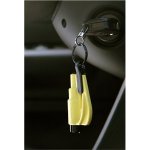
This little guy can get you out of trouble quickly. Whether it means slicing through a seatbelt like a warm knife through butter or breaking a car window with virtually no force, the ResQme window punch is pretty neat. It’s small enough to carry on a keychain or in a glove compartment and it just might make the difference between getting out of your car alive.

Self-Powered Radio with Emergency Hammer & Seatbelt Cutter ($11)
Not sure how great it is, but it’s an interesting concept. SwissTech has combined a hand-crank powered radio with a hammer and a seatbelt cutter. Unbelievably it is priced less than the ResQme…


Solar Cell Phone Charger ($28)
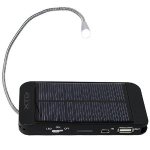
Maybe you like the idea of a solar charger without the need to carry a portable solar panel around (especially one that costs a hundred skoots). Then this device might be perfect for you. It has a USB port for charging your portable devices (as well as an onboard battery) and even a reading light LED.

Share this:

  • Email a link to a friend (Opens in new window) Email
  • Share on X (Opens in new window) X
  • Share on Facebook (Opens in new window) Facebook
  • Share on Pinterest (Opens in new window) Pinterest
  • Share on Reddit (Opens in new window) Reddit
Like Loading...

Disaster Myth Buster # 2: Only the Gov’t Responds to Disasters

12 Thursday Jan 2012

Posted by toddjasper in EMERGENCY MANAGEMENT

≈ 1 Comment

Onward with the Disaster Myth Buster Series! Myth #2 is: “Disaster response and recovery is solely a governmental responsibility”

Valerie Lucus-McEwen recently quoted FEMA Deputy Administrator, Richard Serino, in her blog, saying that upon visiting Joplin, Missouri, the media asked Mr. Serino “‘Can FEMA handle this disaster?’  His response:  ‘If we were doing this alone – no, we couldn’t.'”

“Whole Community” Approach Includes Volunteer Organizations
Mr. Serino wasn’t being modest. Simply, the Federal government is not designed, nor able, to perform comprehensive response and recovery operations in a vacuum. FEMA’s “Whole Community” approach is the codification of the reality that the government is a partner in, not the sole proprietor of, disaster response and recovery. As David Kaufman, director of FEMA’s Office of Policy and Program Analysis, recently wrote in FEMA’s blog, “Woven throughout the [Whole Community approach] and supported by several examples are three key Whole Community principles that emerged through the national dialogue: [1]understand and meet the actual needs of the whole community; [2] engage and empower all parts of the community to define their needs and [3] provide ways to meet them; and strengthen what already works well in communities on a daily basis to improve resiliency and emergency management outcomes.”

For the longest time, FEMA’s role was binary: disaster relief funding and technical assistance. Meaning, following a disaster declaration, FEMA would implement its program for funding relief (primarily through Public Assistance and Individual Assistance). As needed, FEMA could also call on partner Federal agencies to provide technical assistance, such as engineers from the US Army Corps of Engineers or livestock specialists from the USDA. With programs like Project Impact and Whole Community, FEMA is providing more than just a checkbook or a phonebook. FEMA is acknowledging a deeper role as a facilitator, coordinator, and partner to states, tribes, communities, and the private sector. By “winning hearts and minds” at the local level, FEMA benefits from a “force multiplier” effect.

Volunteer Organizations Active in Disasters
While many people recognize the American Red Cross, there are dozens of other hardworking volunteer organizations present in the disaster response and recovery arena. In fact, together these organizations are referred to as “Volunteer Organizations Active in Disaster” or VOAD. VOAD are so important to FEMA that Mr. Fugate spoke at the National VOAD conference in May 2010, explaining that “It’s the faith-based and non-profit groups that know their communities best, and by strengthening the partnerships between us, we can help keep the people we serve safe.”

Ben Curran, the voluntary agency coordinator at FEMA (and having served FEMA since 1989), released a list of reasons why VOAD are so important and uniquely helpful as a complement to Federal disaster response/recovery. Here are several selected bullet points:

  • VOAD is a “go-to” institution at the national and State levels where new organizations learn how to get involved in emergency management.
  • VOAD can be innovative, creative, flexible, and pro-active when government often cannot be.
  • VOAD organizations are trusted in the community they serve, providing for year-round social needs, and as a result may be able to address problems more thoroughly than government can.
  • VOAD diversity sets an example for FEMA, compelling FEMA’s work with  all faiths and secular groups — large, small, urban, and rural.
  • VOAD serves as a voice to FEMA for the country’s very diverse NGO community.
  • VOAD members serve undocumented households during disasters and all communities in non-Presidentially declared disasters – two major gaps not addressed by government
  • State VOAD representatives in State Emergency Operations Centers can play key partnering roles for government through extensive networks and collective influence.
  • State VOADs greatly assist the FEMA VAL in the early stages of a disaster operation with State introductions, contacts, networks, and historical experience.
  • National VOAD provides key input into strategic planning development for FEMA.  For example, the National Disaster Housing Strategy.
In the end, this myth is pretty simple to disprove since so many excellent agencies are sending volunteers to disaster sites routinely. Some of the best known organizations are: Habitat for Humanity, Human Society of the United States, Mennonite Disaster Service, National Organization for Victim Assistance, Presbyterian Disaster Assistance, United Way, Salvation Army, Samaritan’s Purse, Jewish Coalition for Disaster Relief, and Feed the Children. Without the support and involvement of VOADs as well as private sector support (an entirely separate future blog entry), diaster response and recovery is–at best–incomplete.

Share this:

  • Email a link to a friend (Opens in new window) Email
  • Share on X (Opens in new window) X
  • Share on Facebook (Opens in new window) Facebook
  • Share on Pinterest (Opens in new window) Pinterest
  • Share on Reddit (Opens in new window) Reddit
Like Loading...

The Integrated Planning System (IPS): The Best Kept Secret in Planning

09 Monday Jan 2012

Posted by toddjasper in CONTINUITY OF OPERATIONS, EMERGENCY MANAGEMENT, HOMELAND SECURITY, PREPAREDNESS, RECOVERY, RESPONSE

≈ 2 Comments

Tags

department of homeland security, hierarchy of plans, secretary of the department of homeland security, vertical and horizontal integration

Never heard of IPS?
In December 2003, Homeland Security Presidential Directive (HSPD) 8 was signed by the President, and, among other things, included a requirement for the Secretary of the Department of Homeland Security (DHS) to develop an integrated planning system (IPS) (released in January 2009)

IPS was designed to include six areas of importance: national planning doctrine, a system for identifying courses of action, a standard method for incorporating lessons learned, a process for linking tribal, local, state, and regional plans with Federal planning, a process for fostering vertical and horizontal integration of planning with all levels of government, and finally, a guide for for all-hazards planning. Incredibly, IPS accomplished its mission! 

NIMS references IPS, explaining that “while it is recognized that jurisdictions and organizations will develop multiple types of plans, such as response, mitigation, and recovery plans, it is essential that these plans be coordinated and complement one another. State, tribal, and local governments are encouraged to comply with the Integrated Planning System…” The only problem: IPS is so technical that few can stomach it. IPS never really caught on. Few people have implemented it.

How I learned to love IPS:
After Hurricane Ike in 2008, I was a contractor for FEMA using a draft version of IPS to perform strategic recovery planning at the JFO in Austin, TX. As a planning geek, I really like IPS. I liked it so much, that after our team wrapped up in Austin, I continued work at FEMA HQ in DC to develop a strategic recovery planning toolkit based on operationalizing IPS.

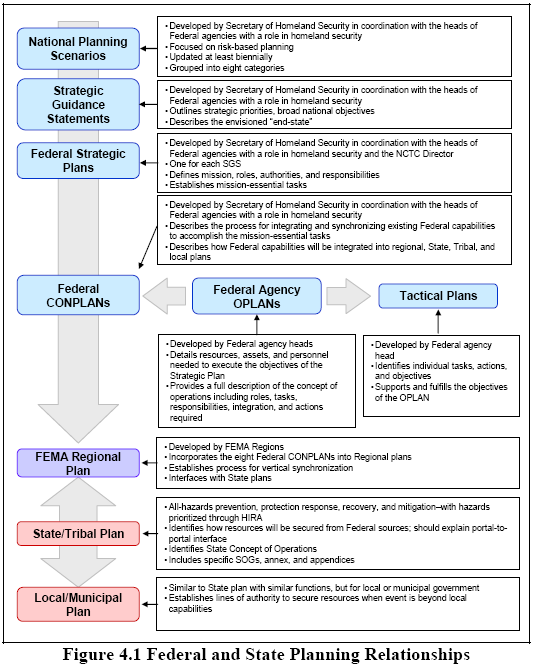
I discovered that IPS held a powerful framework and process for planning that provided insight to some the problems I’d experience with planning. As any planner will tell you, in large organizations, one plan seems to beget another plan, which begets yet another plan. Developing a hierarchy of plans is important for vertical integration–especially for large agencies or organizations with complex missions. But without IPS, there was no standardization in the Federal government emergency management plans.

But at less than 100 pages, IPS was a very brief adaptation of military planning doctrine, mainly the Joint Operational Planning and Execution System (JOPES). JOPES is the framework by which the US armed services plan operations together. For example, let’s say a mission in Adversariland was needed that required the Air Force to provide air cover, the Navy to soften beach defenses, Marines to create a beachhead, and soldiers to capture and hold a certain area. That “operation” is considered “joint” because it includes several different branches of the military. In my opinion, if JOPES is able to get marines, soliders, sailors, airmen, and coasties to all talk to one another and plan operations (even if it is only implemented at the highest ranks), it seems like it must have lessons that civilians could learn as well.

Vertical Integration:
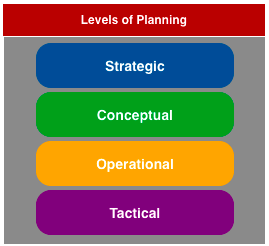
In order to better understand IPS, I researched JOPES by reading publicly accessible JOPES training documents and manuals, such as the user guide for JOPES and the precursor to Joint Publication 5-0. JOPES can help civilian planners understand the various levels of planning (see above for the colorful table I made) and how plans that jumble all the levels together are poorly written and disjointed. A plan that drops from strategic level to tactical level is like an elevator without brakes. Vertical integration among complex, disparate organizations takes a strong foundation (found in IPS).

Whole Community = Comprehensive EM + Vertical Integration
For the FEMA “Whole Community” approach to work (which, at its core is decades of refining “comprehensive emergency management”), vertical integration is required. How can local plans integrate with regional plans, which integrate with state-level plans, which integrate with Federal plans and the 15 National Planning Scenarios? An integrated planning system accomplishes this audacious feat. Just when this whole system was about to work and progress the “whole community” ideology…

IPS…Gone, but not Forgotten…
At the end of March 2011, Presidential Policy Directive-8 (National Preparedness) was signed, rescinding HSPD-8 (the foundation of IPS). Although PPD-8 calls for the development of the National Preparedness Goal (released in Sept 2011) and the National Preparedness System (description released in Nov 2011), the foundational elements of IPS are lost. In its place are core capabilities, which are generic program elements, such as Planning, Public Warning and Coordination, and Operational Coordination. While I understand the change and I can appreciate the gained ease-of-use of some parts of the National Preparedness System (by the way, now we’re going to be getting National Planning Scenarios and the National Preparedness System confused…), I feel a tinge of loss for IPS. IPS is sound planning doctrine and provides an introduction to planning that the next generation of planners and emergency managers ought to have the benefit of learning.

Let’s hope the National Planning System can catch the attention of more planners and become the accepted standard that IPS wasn’t. If “whole community” is to be a reality, it will take a strong, integrated planning system.

Share this:

  • Email a link to a friend (Opens in new window) Email
  • Share on X (Opens in new window) X
  • Share on Facebook (Opens in new window) Facebook
  • Share on Pinterest (Opens in new window) Pinterest
  • Share on Reddit (Opens in new window) Reddit
Like Loading...

Disaster Myth Buster #1: Mass Panic

04 Wednesday Jan 2012

Posted by toddjasper in EMERGENCY MANAGEMENT

≈ Leave a comment

Last month I kicked off my “Disaster Mythology” series. The first disaster myth I listed was: Disasters bring out the worst in society (also addressing “mass panic”).

Myth defined: After a large disaster, society breaks down causing chaos and anarchistic conditions. Examples: John Gibson from Fox News during Hurricane Katrina explained that there were “All kinds of reports of looting, fires and violence. Thugs shooting at rescue crews…” On MSNBC, Tucker Carlson stated “People are being raped…People are being murdered. People are being shot. Police officers being shot.” Even the Chief of Police for NOPD went on the Oprah show and claimed that babies were being raped. In reality, there were very few official reports of rapes or murders. Chief Compass explained later that “We don’t have any substantiated rapes. We will investigate if they come forward.”

In fact, it doesn’t need to be an actual disaster for people to consider the worst. In preparation for Y2K, Japan put 96,000 soldiers on heightened alert and the entire world felt a sense of impending doom. There were many predictions in the media of mass chaos and widespread panic.

In essence, the myth revolves around the notion that after a large disaster, there will be societal collapse due to decentralization of power/protection and resulting in anarchy.

In response to that myth, here are some facts that form a rebuttal:

Mass panic? Turns out mass panic is pretty rare. An example provided by Erik Auf der Heide:

Hurricane Carla, Galveston, Texas, 1961. Carla was a category-5 hurricane, the highest level on the Saffir-Simpson scale. It was the worst hurricane to hit the Texas coast in 40 years, having sustained winds of over 150 miles per hour as it positioned itself to strike the mainland. Headlines in several newspapers reported, “More than 100,000 persons flee in near panic.” Actually, 70–80% of those on Galveston Island remained during Carla, even though most knew they would be cut off from the mainland. Islanders boasted of having had beach parties during the hurricane.
In fact, hurricane parties are fairly common (see hurricane parties for Hurricane Ike, Hurricane Camille, and Hurricane Andrew).

Sociologists have long identified substantial disconnects between public perceptions of post-disaster human behavior and the empirical assessments of that behavior. After many disasters, researchers, reporters, and public officials have been unable to corroborate the majority of harsh reports regarding rapes, murders, and chaos. In fact, there is often a sense of community that develops before, during, and after a disaster. As Ms. Sun points out: “Indeed, community residents who survive the initial hazard event are the true “first responders,” performing many critical lifesaving tasks, including searching for, rescuing, and caring for other survivors. The research also suggested that true panic—characterized by irrational flight behavior—is not a typical disaster response”.

Looting is more common during riots but is actually rare during disasters. As the Suburban Emergency Management Project points out, looting is more often a fear than an actuality during disasters. In a poll taken in 1990 by the Project, they found a majority of emergency managers agreed with the statement that “looting rarely occurs before or after a disaster.”

Anarchy? Not so much… After Hurricane Katrina, a report by the New Orleans newspaper, the Times-Picayune, stated: “Four weeks after the storm, few of the widely reported atrocities have been backed with evidence. The piles of bodies never materialized, and soldiers, police officers and rescue personnel on the front lines say that although anarchy reigned at times and people suffered unimaginable indignities, most of the worst crimes re- ported at the time never happened.” This article won the Pulitzer Prize for Public Service. Some think that the anarchy motif is a way for more resources to be devoted to a disaster–especially in the form of military might. Others say it’s just media sensationalism and the current equivalent to yellow journalism.

—————————————————————————————————-

Some good articles disproving this myth:

Common Misconceptions about Disasters: Panic, the “Disaster Syndrome,” and Looting by Erik Auf der Heide

Disaster Mythology and the Law by Lisa Grow Sun (Cornell Law Review)

Share this:

  • Email a link to a friend (Opens in new window) Email
  • Share on X (Opens in new window) X
  • Share on Facebook (Opens in new window) Facebook
  • Share on Pinterest (Opens in new window) Pinterest
  • Share on Reddit (Opens in new window) Reddit
Like Loading...
← Older posts
Newer posts →

Enter your email address to follow this blog and receive notifications of new posts by email.

Join 49 other subscribers

Recent Posts

  • Todd’s Interview: “Questions Raised about Police Response in Capitol Shooting”
  • Todd’s NPR Interview on Tragic Navy Yard Mass Shooting
  • 5 Reasons Your Agency Should Have a Smartphone App
  • FEMA Releases Revised Federal Continuity Directive 2 (FCD-2)
  • Intro to IAEM Emerging Technologies Caucus (ETC)

Todd’s Tweets

Tweets by toddjasper

Categories

  • #SMEM
  • ABOUT TODD
  • CAMPUS SAFETY, SECURITY, & PREPAREDNESS
  • CONTINUITY OF OPERATIONS
  • EMERGENCY MANAGEMENT
  • EMERGENCY NOTIFICATION
  • HOMELAND SECURITY
  • PREPAREDNESS
  • PUBLIC HEALTH
  • RECOVERY
  • RESPONSE

Blog at WordPress.com.

  • Subscribe Subscribed
    • toddjasper
    • Join 49 other subscribers
    • Already have a WordPress.com account? Log in now.
    • toddjasper
    • Subscribe Subscribed
    • Sign up
    • Log in
    • Report this content
    • View site in Reader
    • Manage subscriptions
    • Collapse this bar
 

Loading Comments...
 

    %d